PlanetJune Craft Blog
Latest news and updates from June

PlanetJune Blog: Latest News, Patterns and Tutorials

Iguana crochet pattern

If you saw my chameleon photoblog the other day, you’ll know I have lizards on the brain. I’ve already designed a gecko and a chameleon though, so I needed a different type of lizard to complete my lizard crochet pattern trilogy. An iguana seemed like the obvious choice, with lots of fun details to include, so that’s what I’ve made:

iguana amigurumi crochet pattern by planetjune

Iguana Fun Facts

  • My design is based on the Green Iguana, which lives in rainforests in Central and South America (although if you change the colour you could make different types of iguana).
  • Other types of iguana are adapted for different environments, such as the Marine Iguana from the Galapagos islands (which eats seaweed and algae and is an excellent swimmer), and the Desert Iguana from the southern US and Mexico (which can withstand high temperatures and burrows into sand to keep cool).
  • The Green Iguana is about 2 metres long, and is easily recognised by its dewlap (the loose skin under its chin), the row of spikes down its back and its very long tail.
  • Despite its size and fearsome appearance, the Green Iguana, like other iguanas, is primarily a herbivore.

I think I struck a good balance with this design between realistic and cute, detailed and easy to crochet. He’s worked in two shades of green, although a single-coloured iguana would look nice too; you’d just lose the tail striping. He’s an incredible 15″ (38cm) long, although, don’t worry, most of that is tail – he’s only 9″ (23cm) long excluding the tail πŸ™‚

iguana amigurumi crochet pattern by planetjune

Let’s look at that tail for a moment – it’s a perfect excuse to practice my seamless, jogless Perfect Stripes: No-Cut Join technique, although the pattern includes a standard jogless stripes technique for those who aren’t feeling adventurous and don’t mind a slight visible seam in the tail.

The realistic legs are wired with pipe cleaners, but the pattern also includes tips for omitting the pipe cleaners if you want your iguana to be baby-safe.

iguana amigurumi crochet pattern by planetjune

As with all my crochet patterns from now and going forward, any pieces not worked in simple amigurumi style include a stitch diagram in addition to the written instructions, so you can use whichever instructions work best for your learning style. And, as always, photos aid with every step of the assembly, so you can be confident you’ll be able to make a perfect iguana too.

I hope you’ll enjoy my latest pattern! If you’d like to jump right into iguana-making, you can pick up the Iguana amigurumi crochet pattern right now from my shop. Or, if you’re not quite ready to buy, why not favourite/queue it on Ravelry so you don’t forget about it?

Comments (13)

South Africa wildlife I

I’ve renamed my nature photoblog series from ‘Cape Town wildlife’ to ‘South Africa wildlife’, to distinguish these new occasional posts from my previous month-by-month year of wildlife posts. It’s been a long time since I last posted nature photos (9 months!), so I have a lot of special things saved up to show you, when I have time to organise and edit my thousands of photos! I’ll ease back into the wildlife blogging with a study of one of my favourite local animals…

I like to play ‘spot the chameleon’ in my garden. It’s like a real-life version of Where’s Wally/Waldo, only with a much better reward: you get to watch the tiny adorably grumpy-faced lizard after you spot him, and, because chameleons don’t dart off in a split second like geckos do, it’s much easier to take good photos.

I have no idea how many Cape Dwarf Chameleons live in, or visit, our garden. My best guess is ‘several’, and I choose to believe that they are all babies of Kermy, the chameleon I used to watch every day last year (and even fed a grasshopper to, on one magical occasion). Look how difficult it is to spot the (full-sized) Kermy:

cape dwarf chameleon

There he is! In dark colour mode:

cape dwarf chameleon

And in bright colour mode, with my hand for scale:

cape dwarf chameleon

Now imagine how much more difficult the chameleon-spotting game is when they are teeny-tiny babies like this:

cape dwarf chameleon

Awww! And it’s not just the size that makes it tricky; they change colour like crazy! Here’s another baby (these are all the same species btw, Cape Dwarf Chameleons):

cape dwarf chameleon

Look at the amazing colours!

cape dwarf chameleon

I was even more excited though, when I saw this completely different type of baby chameleon…

cape dwarf chameleon

(who, incidentally, has a pretty neat way of hiding when he sees you coming…)

cape dwarf chameleon
Where did he go?!

…only to discover the next day that his grey colouring was just skin getting ready to shed and he was a regular green chameleon all along! I could hardly believe it, but I have proof: here he is with just the nose skin left:

cape dwarf chameleon

And then I spotted this very skinny orange baby on the same bush, so I know for sure that there are at least 2 of them:

cape dwarf chameleon

The next day, I managed to catch one of them napping! Awwww….

cape dwarf chameleon

Then I didn’t spot any for a couple of weeks until yesterday, when I found this one – he’s much bigger now, and starting to look more like his daddy, my old friend Kermy πŸ™‚

cape dwarf chameleon

You can probably tell that I’m pretty smitten with these little guys…

I almost wish I hadn’t already designed my chameleon crochet pattern last year, because I’m just not getting over this fascination, so I settled on the next best thing: I’ve designed a different lizard pattern to indulge in my newfound appreciation for reptiles. (It’s a cute one, and I’ll be revealing it very soon…)

I really hope you’ve enjoyed my chameleon photos – please leave me a comment if so. I promise I’ll try not to leave such a long gap until my next wildlife report πŸ™‚

Comments (27)

Valentine’s CAL roundup

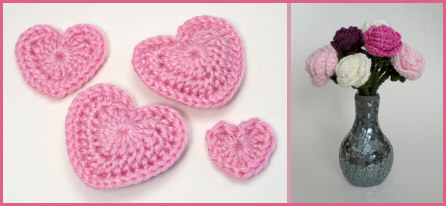
Happy Valentine’s Day! Whether or not you’re celebrating today, here are some pretty crocheted hearts to brighten your day from our Valentine’s mini-CAL. (Don’t forget to keep reading to the end – we have a new prize CAL starting tomorrow!)

Read the rest of this entry »

Comments (3)

knitted lace hat

I actually wrote this post long before Christmas, but it’s been too hot to even consider modelling a warm hat until now, so let’s pretend I just finished it – I want to tell you the lemons-into-lemonade story of how I ended up with this lacy knitted hat instead of the cardigan or sweater I’d intended to make…
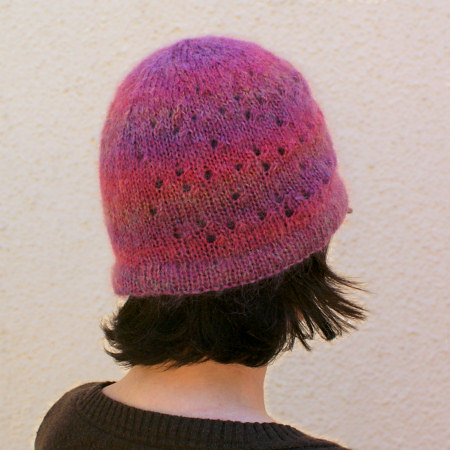
knitted lace hat

After the success of my first knitted cardigan, I needed to get another project started asap so I didn’t revert back to my exhausting pattern of working (crochet designing) while watching TV in the evenings.

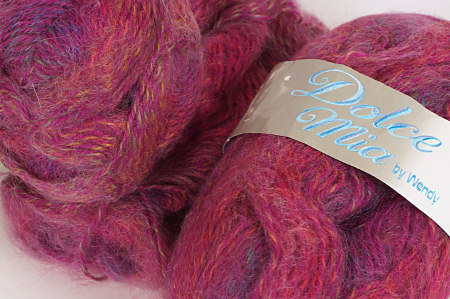
I looked through my stash and found this interesting yarn – it looks like mohair but it’s actually an acrylic/nylon blend… No, it’s not the loveliest yarn ever, but my Mum found it in a charity shop for next to nothing, and I thought I could use it up on some knitting practice before committing to the expense of buying yarn for a sweater. (As there are no big box craft stores here, no weekly sales, no 40% off coupons, I can’t get any bargain yarn any more, so working through my stash is suddenly more appealing to me!)
knitted lace hat

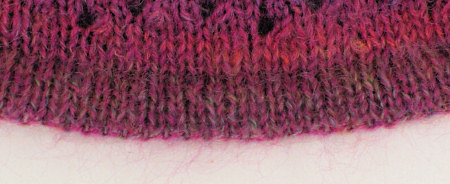
I wanted to try a built-in edge to prevent the stockinette curling this time, so I learnt how to start with a built-in facing and cast-on for the back of my unplanned sweater/cardigan:
knitted lace hat
Built-in facing (look how neat it makes the bottom edge look)

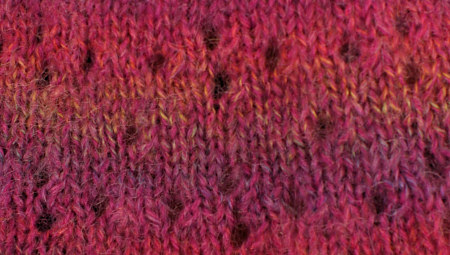
Feeling ambitious, I thought I’d find out how to make knitted lace (i.e. strategically placed holes), and invented a basic pattern to work with:
knitted lace hat
My very basic lace pattern

Disaster 1: After working through my 12-row lace pattern repeat three times (while watching TV and paying very little attention to what I was doing) I held my knitting up and noticed a couple of big mistakes in the position of my lace holes – one in the wrong place and one extra hole that shouldn’t have been there.

Solution 1: Here’s a big advantage of knitting over crochet: if you made a mistake, even many rows back, you can unravel that column of stitches down to the mistake like a ladder in a stocking, fix the mistake, and then zip all the stitches back up again with a crochet hook by hooking each through the last. Mine was a little trickier than fixing a mistake in stockinette, as I had to unravel some lace pattern stitches – decreases and yarn overs – but it worked! Which means that now I can confidently knit without paying much attention to it, knowing that I can fix a mistake later.

Disaster 2: I realised that a) I really don’t love this yarn enough to wear a sweater made from it, and b) knitting lace without making mistakes would take more concentration than I can afford to spend – the whole joy of my knitting is that I can do it mindlessly to stop myself from working on crochet designs out-of-hours, and that doesn’t really apply when getting into more complex stitches and patterns. What’s the point in completing an un-relaxing project to make an un-wearable sweater?

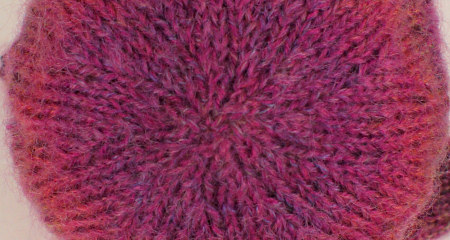
Solution 2: By luck, the bottom hem of my ‘sweater back’ was just the right length to be a hat band. (That’s only because my gauge was a bit off to begin with, and my planned 18″ back was actually 20″ wide – another reason not to continue with this project as a sweater.) So I stopped working my lace pattern and figured out a decrease pattern to make the top of a hat shape instead. I found out that I can extrapolate my crochet shaping knowledge to make knitted shaping pretty easily.
knitted lace hat
Decreases create the top of the hat

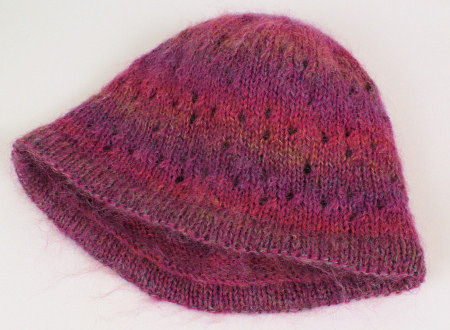
I seamed the two side edges together, and, voilà, a hat is born:
knitted lace hat
I knitted a hat – by accident!

And the bonus surprise from all this: I actually like the hat! I think I could get away with a small accessory in this yarn and colourway, whereas I know for a fact I would never have worn it as a sweater. I’ve never designed a hat before as I’m not really a hat person, but this has actually made me consider designing a crochet hat pattern at some point…

knitted lace hat

I’m avoiding getting fancy with my next knitting project (a sweater). I really like the look of stockinette, and the miles of pulling one loop through another to form a neat even fabric is very soothing to me. Yes, this fabric could be made in minutes on a knitting machine, but there’s still an advantage in making over buying: I can tailor my garments to fit me instead of having to settle for leaving the bottom of every cardigan unbuttoned to accommodate my hips.

Plus, it’s just relaxing to design things without writing anything down or worrying about how it’ll translate into a pattern. Yay for non-work crafting!

Comments (5)

February update

February CALs

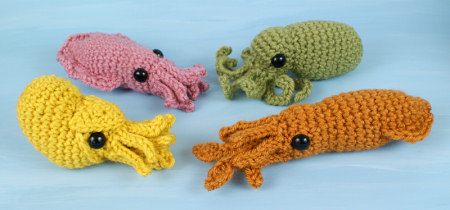
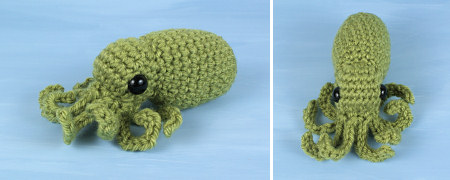
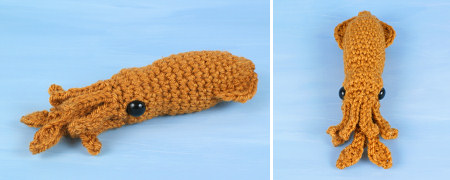
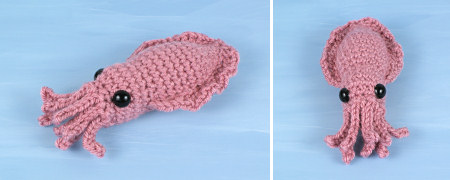
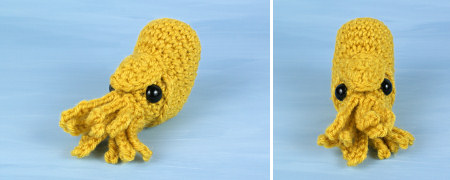
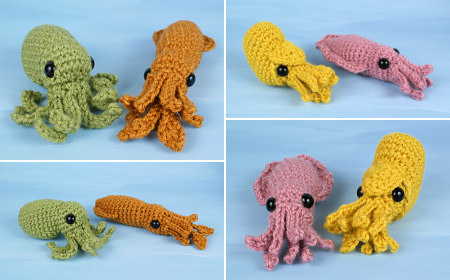
The Baby Cephalopods and other AquaAmi are already starting to multiply in the Ceph-Along (& friends) CAL thread on ravelry. There’s still plenty of time to join in – the CAL runs all month and you can make a cephalopod in an hour or so! One thing I love about these patterns is how few pieces they have; there’s almost no sewing to do (bliss when you’re used to having to stitch head, muzzle, body, 2 ears, 4 legs, and a tail for one animal…)

baby cephalopods crochet patterns by planetjune: octopus, squid, cuttlefish, nautilus

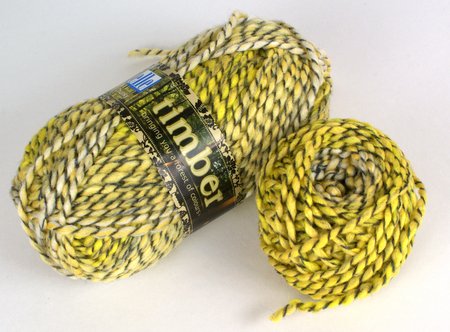
It’s rare that I’m still excited enough about a new pattern to want to make more immediately, but I really can’t resist the cephalopods – they’re just so quick and fun to make. I’ve just bought this insanely-coloured yarn that I think will make wonderful colour-changing cephalopods (I can’t imagine any other uses for it – no wonder the shop had only this colourway left):

elle timber yarn in goldenrain

I’ll be joining in the CAL myself, to see if my gut feeling is correct and I can turn this exuberance of colour into a set of amazing cephalopods….

Valentine's CAL at PlanetJune

And if you’re making hearts and roses from my free patterns, don’t forget to share them in the Valentine’s CAL thread before the 14th and I’ll include your photos in the roundup here!

Review and Win contest

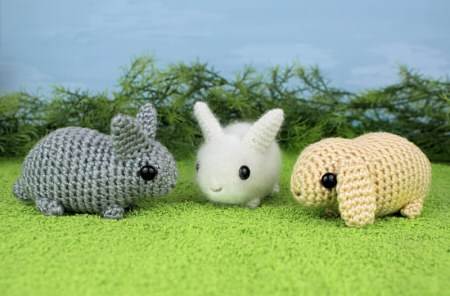
January’s ‘Review and Win’ winner is Emily W, with her review of my ever-popular Baby Bunnies:

Baby Bunnies crochet pattern by PlanetJune

I ABSOLUTELY ADORE THIS PATTERN!!! As soon as I saw the bunny pictures on June’s blog, I was absolutely ecstatic!!! I had previously looked everywhere for a realistic bunny pattern, but hadn’t found anything that looked promising.

As soon as I bought the pattern, I was immediately swept up in a colony of bunnies – I just couldn’t stop making them! The pattern is SUPER easy, even with the odd increases and decreases needed for the shaping. June explains the concepts needed so well, such as the entire page devoted to explaining angora bunny-brushing techniques! I’m also really glad that, unlike some other designers, June always pays great attention to important details, such as: where to put the eyes and ears, and where to put the feet so the bunny doesn’t flop forward or look like it’s pregnant (I speak from experience from my own attempts at designing a bunny pattern… did NOT turn out well πŸ˜› ) Most of all, I love the fact that the bunny pattern is so easy to customize to look like your own bunny.

Everyone I make bunnies from this pattern for loves the results. This pattern will DEFINITELY become my last-minute birthday present pattern! Thank you SO MUCH for yet another wonderful pattern, June!!!!

You’re welcome, Emily, and thanks for the lovely review – I’ll email you to find out which pattern you’d like as your prize πŸ™‚

And for everyone else, Baby Bunnies will be part of the next PlanetJune CAL (Spring/Easter theme), starting Feb 15th, so get ready for BunnyFest 2013, coming soon to a ravelry group near you…

Comments (1)

crocheted cat ‘fishing’ toy

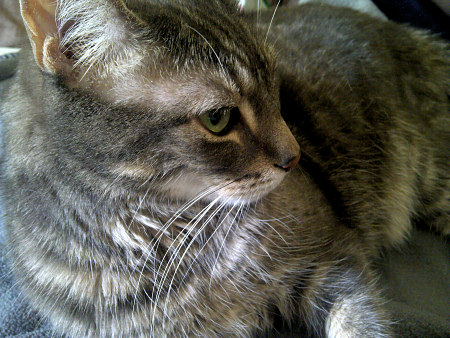
My sweet Maui just celebrated his 9th birthday, so it was time for me to make a new cat toy. Here’s the handsome birthday boy:

Maui on his 9th birthday

We adopted Maui from a shelter when he was a year old. He’s been our constant companion through 3 house moves and a move halfway around the world, and he’s adapted quickly to every change – if we’re with him, he’s happy (and vice versa).

Maui likes to ‘supervise’ my work by curling up next to me when I’m sitting crocheting on the sofa, and he never, ever steals my yarn – he somehow knows the difference between the crocheted balls that I make for him to maul and the ones that are going to be parts of my amigurumi designs and are not to be touched!

As he’s such a special cat, I wanted to make Maui a special toy for his birthday. The problem is that I’ve made him lots of toys before, and as he still loves the old ones, it’s getting harder to come up with different ideas. So I mixed and matched ideas from some of his other favourite toys, and enlisted my husband’s help for a quick bit of woodwork as the finishing touch.

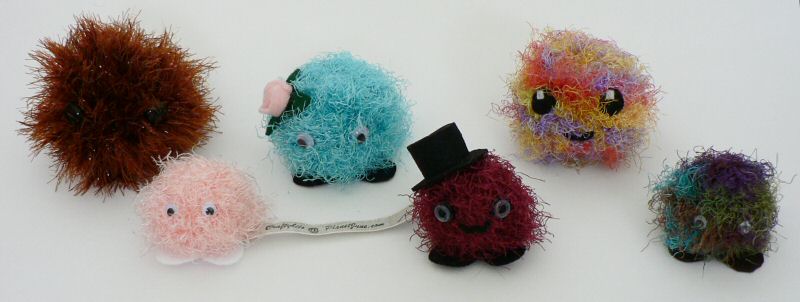
I started with a crocheted fuzzy ball (based on my Fuzzballs pattern and a good way to use up some eyelash yarn).

fuzzballs by planetjune
I reused the same ‘interesting’ shade of yarn as that Fuzzball in the top right corner, which, despite losing its eyes and mouth many years ago, is still one of Maui’s favourite toys.

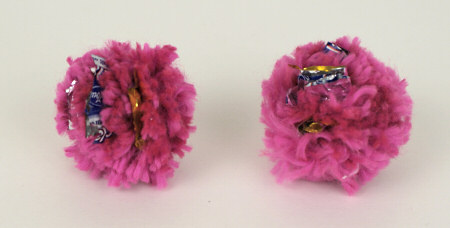
Then I added some metallized plastic chocolate wrappers for that irresistible crinkly noise (idea borrowed from last year’s Crinkle Ball Cat Toy tutorial).

crinkle ball cat toy tutorial by planetjune
These were firm favourites for months but look a bit bedraggled now. I think it may be time to make some replacements – luckily I have a tutorial to remind me of the method πŸ™‚

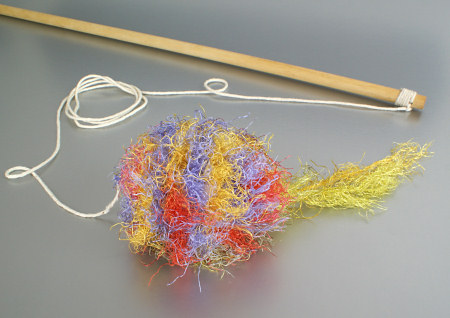
I scrunched up the chocolate wrappers to stuff inside the ball, and also added a little pouch of catnip. I tied the ball to a long string, and left some dangling lengths of eyelash yarn on the other end of the ball for extra interest. Dave cut down a length of dowel and drilled a hole in one end so I could tie the string to the pole securely. And here’s the result:

crocheted cat 'fishing' toy on a string by planetjune

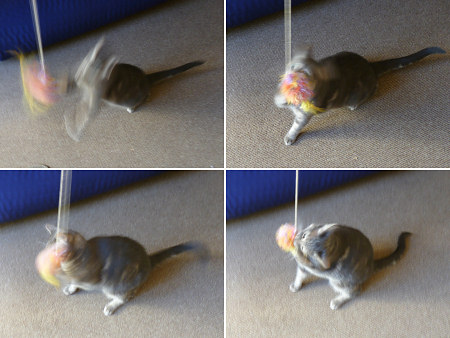
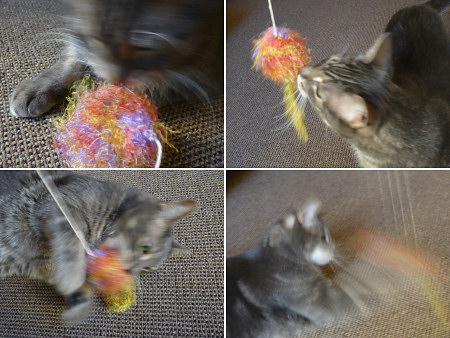
It’s a very interactive cat toy: it appeals to sight (dangling yarn tails), sound (crinkly stuffing) and smell (catnip) and brings out Maui’s hunting skills as he runs and jumps after the moving toy. Here’s proof:

crocheted cat 'fishing' toy on a string by planetjune
You know it’s a good cat toy when the only photos you can take are full of motion blur…

For an older or less active cat, toys on strings are really good for keeping kitty’s interest and enticing him to move, jump, and pounce. A plain ball or mouse gets boring, as it doesn’t move unless kitty moves it or you throw it for him; a ‘fishing line’ toy like this, with a string and a long handle, lets you keep the toy in motion, and your cat interested, without too much effort on your part. I’ve tied strings to toys before, but the pole makes it much easier to jerk the toy about enticingly…

crocheted cat 'fishing' toy on a string by planetjune

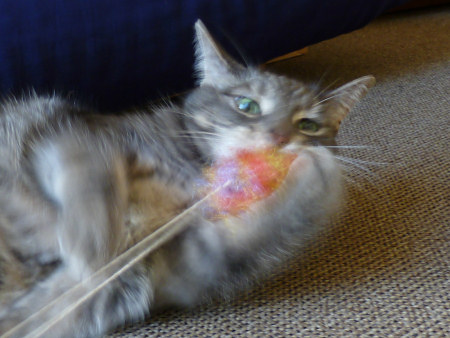
Maui definitely likes his birthday present – I’ll call that mission accomplished!

crocheted cat 'fishing' toy on a string by planetjune

Comments (8)

Pet-Along CAL roundup

It’s been a fun month of making and sharing crocheted pet animals in the Ravelry group, using all my pet patterns:

PlanetJune Pet-Along crochet-along patterns

And now it’s roundup time! (Don’t forget to keep reading to the end to see what CAL themes we have in store for February.)

Read the rest of this entry »

Comments

Perfect your invisible decreases

The invisible decrease (invdec) is one of the two absolutely essential techniques for making beautifully neat amigurumi (the other being, of course, the magic ring). But invdec is a little tricky to get the hang of, and there are 2 points during the decrease where you can accidentally lengthen your stitch so it isn’t neat and tight, and the resulting decrease will be far more obvious.

Today I’d like to demonstrate these invdec problem points, so you know where the pitfalls are, and how to avoid them. You’ll find this tutorial useful if:

  • You’re new to the invisible decrease technique (watch my video tutorial before you continue reading this!)
  • You’ve tried invdec but been disappointed by your results
  • Your invdecs look inconsistent, gappy, or too prominent
  • You want your amigurumi to look as good as possible!

Continue to the Invisible Decrease Tips tutorial >>

Comments

    navigation: arrow

    buy crochet patterns and accessories from my online store

    'Everyday Crochet' and 'The Essential Guide to Amigurumi' crochet books by June Gilbank

    Crochet video tutorials and step-by-step photo tutorials

    Free PlanetJune crochet patterns

    Frequently Asked Questions

    navigation: arrow

    Punchneedle Embroidery information, ebook & patterns

    Papercraft ebook & tutorials

    Free PlanetJune craft projects & tutorials

    PlanetJune Under the Sea CAL
    Ravellenic Games: Team PlanetJune
    PlanetJune Reindeer Games
    PlanetJune Temperature Snake CAL

    June Gilbank

    Hi, I'm June. Welcome to my world of nature-inspired crochet and crafting. I hope you enjoy your visit!

    If you'd like to get in touch, you can contact me here.
    crocheted Canadian flag by PlanetJune
    Proudly made in Canada!
    A fanned-out pile of the books Everyday Crochet and The Essential Guide to Amigurumi, with text 'The answers to all your crochet questions at your fingertips - find out more'

    Has my work helped you?

    You can also send me a donation through my shop, or simply click ♥ Support PlanetJune ♥ before you shop at Amazon, Etsy, KnitPicks, and more, and I'll make a small commission on your purchase, at no cost to you!

    Tip: This link is also in the footer of every page!

    Thank you so much for your support!