my book: Paper Chains & Garlands
FINALLY! I can give you a sneak preview of my papercraft book, Paper Chains and Garlands. After months of waiting, it’s wonderful to see how my projects, text and illustrations have been transformed into a thing of beauty… And it’s not only a book, it’s a kit!
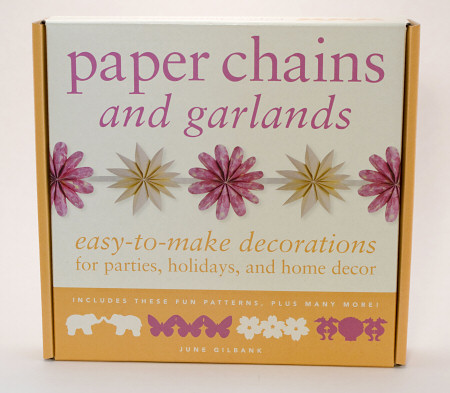
Front of box
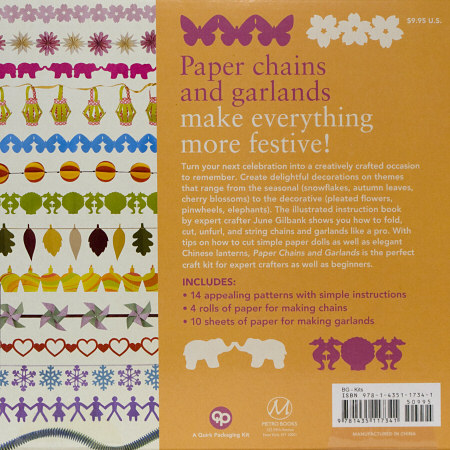
Back of box with pictures of all the projects down the left hand side
For those of you without a magnifying glass, the back of the box reads:
Paper chains and garlands make everything more festive! Turn your next celebration into a creatively crafted occation to remember. Create delightful decorations on themes that range from the seasonal (snowflakes, autumn leaves, cherry blossoms) to the decorative (pleated flowers, pinwheels, elephants). The illustrated instruction book by expert crafter June Gilbank shows you how to fold, cut, unfurl, and string chains and garlands like a pro. With tips on how to cut simple paper dolls as well as elegant Chinese lanterns, Paper Chains and Garlands is the perfect craft kit for expert crafters as well as beginners.
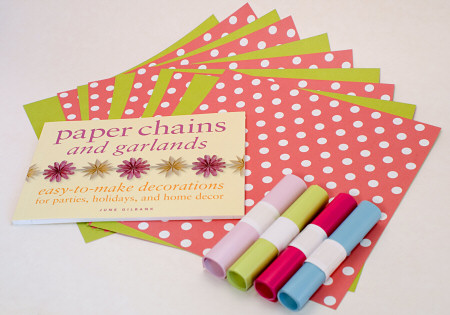
Inside the box: the book, 4 rolls of paper chain paper and 10 sheets of double-sided garland paper
The book has full illustrated instructions for all 14 projects and includes full-size templates.
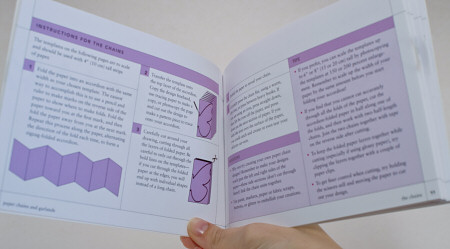
Inside the box: the book, 4 rolls of paper chain paper and 10 sheets of double-sided garland paper
Drawing all the step-by-step illustrations took me sooo long, but I’m really happy with how clear and colourful it all looks. The inside of the book isn’t all purple, by the way – the instructions and illustrations for each project match the colours in the actual project – it’s so pretty!
Paper Chains & Garlands will be available in Barnes and Noble stores and from www.bn.com from September 30th 2009 – that’s just over a week from now!
I was hoping to be able to sell signed copies from my shop, but sadly due to the box being over 2cm thick, Canada Post would charge me $8 (Canada), $9 (US) and $16 (International) just to ship the book, which I doubt any of you guys would be willing to pay for a $10 book, right?! 🙁
I think it’s a really cute kit and I hope it’ll do well. Now I just have to wait until the 30th and see what people think of it!