PlanetJune Craft Blog
Latest news and updates from June

PlanetJune Blog: Latest News, Patterns and Tutorials

Mushroom Collection & Variations crochet patterns

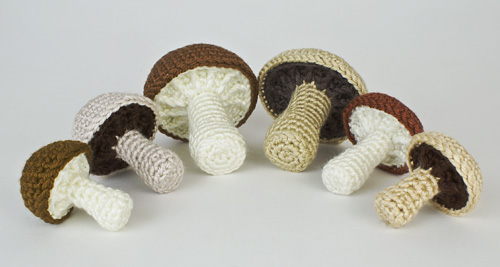
I have two new Fall-themed patterns to launch today: my new Mushroom Collection, and an Expansion Pack so you can crochet even more types of mushrooms!

Mushroom Collection crochet pattern

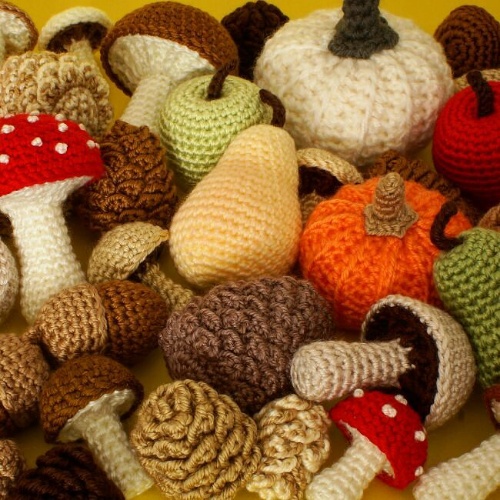
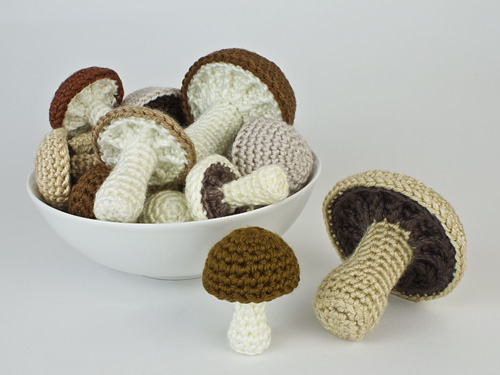
The Mushroom Collection includes 6 different realistic mushroom designs (3 domed and 3 flat, each in small, medium and large sizes). All the mushrooms in this collection are perfectly shaped, with gills hidden under the caps and a crisp colour change between cap and gills. They all use the same techniques, so once you’ve learnt them with your first mushroom, you’ll be able to whip up more in no time!

Mushroom Collection crochet pattern by PlanetJune

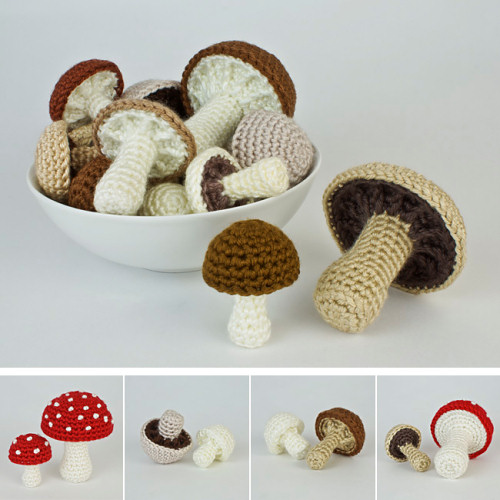
Choose the shapes and sizes you prefer, or create a mixed arrangement in a variety of shades of white and brown. Pile them in a bowl, arrange them on a window ledge, or add them to a seasonal centrepiece or wreath.

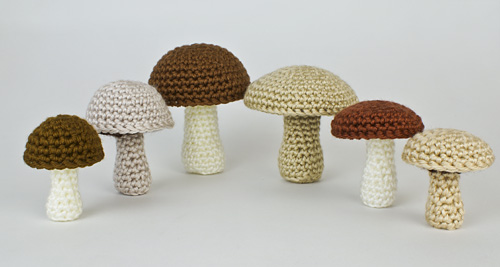
Mushroom Collection crochet pattern by PlanetJune

I’ve shown my mushrooms with either a dark cap and pale base, or a neutral cap and stem with dark gills, but you could also make a single-coloured mushroom, or one with different colours for the cap, gills and stem, giving 4 different colour options for each style of mushroom.

Mushroom Collection crochet pattern by PlanetJune

The mushrooms don’t use much yarn (15-35m each, depending on size/style) and look good in all sorts of colours, so they make great stashbusters! And you can stick with my neutral shades or get more whimsical with brightly-coloured caps – it’s completely up to you.

Mushroom Variations Expansion Pack

This Expansion Pack includes all the modifications required to crochet each of the mushrooms in the Mushroom Collection with any/all of these variations:

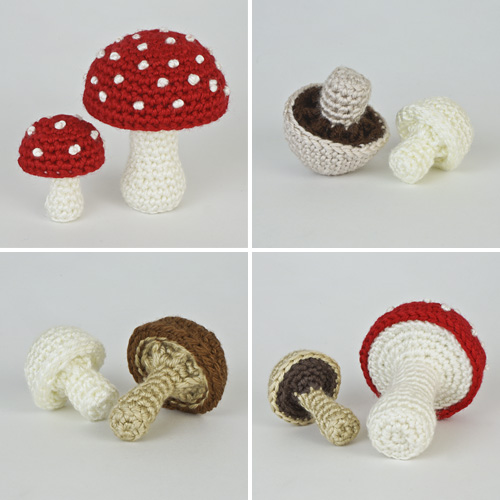
Mushroom Variations Expansion Pack crochet pattern by PlanetJune

  1. Red and White (top left): This colour scheme makes beautiful decorative mushrooms (perfect for Christmas!)
  2. Short Stem (top right): Especially good for play food – these mushrooms look good enough to eat.
  3. No-Sew (bottom left): A speedy crocheted alternative to the standard needle-stitched finish.
  4. No Gills (bottom right): A quick and easy option – great if you want to whip up a large batch of mushrooms in a hurry.

What is an Expansion Pack?

Expansion Packs by PlanetJune

  • An Expansion Pack is an add-on to an existing PlanetJune pattern.
  • The Expansion Pack lets you modify or add to the original pattern to create something else.
  • You cannot use the Expansion Pack alone – you must also purchase the original pattern in order to be able to complete the pictured items in the Expansion Pack pattern.

You can pick and choose to apply any or all of the modifications to any of the six mushroom sizes and styles from the Mushroom Collection, making 96 distinct mushroom possibilities (or 384 if you include the different colour options!)

All the variations (apart from the Red and White) make the mushrooms faster to crochet/assemble.

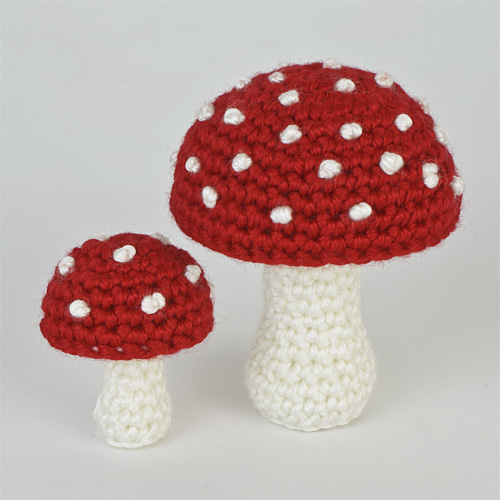
Red and White - Mushroom Variations Expansion Pack crochet pattern by PlanetJune

The spots on the Red and White mushroom obviously take a little more time (especially for the large one!), but the result is so cute, and they’d make gorgeous Christmas decorations as well as Fall decor, so you can repurpose them and keep them on display for months 😉

Fall CAL

We’d love to see the mushrooms you’re making in the PlanetJune group on Ravelry – you can make mushrooms galore (or any other fall-themed PlanetJune designs) as part of the current crochet-along. The CAL runs through till the end of November, so there’s time to crochet a whole variety of different mushrooms…

I hope you’ll join us – I can’t wait to see all the combinations that sprout up!

Links to Buy & Launch Discount

As with all my Expansion Packs, you can buy the patterns separately (although please note that you do need the base Mushroom Collection pattern to be able to make any of the Mushroom Variations), or there’s a discount when you buy both together.

But to sweeten this deal even more and give you an incentive to join the CAL right away, I’m offering an additional discount on the Multipack Set (Mushroom Collection & Variations) if you buy within the next 7 days, so you can get endless mushroom options for only $7.00!

So, here are your options:

Or, if you’re not ready to buy yet, click through to Ravelry and favourite/queue them so you won’t forget about them!

Mushroom Collection & Variations crochet patterns by PlanetJune

I didn’t think I’d ever be tempted to call mushrooms gorgeous, but these designs look so decorative, I think I might change my mind on that front: they’re both realistic and stylised, and the more you make, the better they look together…

What do you think? I hope you’ll have as much fun choosing colours and crocheting mushrooms as I did while designing them 🙂

Comments (5)

new PlanetJune shop features

I’ve just finished upgrading the PlanetJune shop with some helpful new features that I think you’ll enjoy, as well as a host of small functional and cosmetic updates to make the shop easier to use and bring the graphics in line with the rest of the site.

I’m really excited about the new features I’ve built, so let’s have a look at them now…


Save for Later

This first feature will be useful for everyone – I’ve added a ‘save for later’ option in the shopping cart. I’m sure you’ll already be familiar with this functionality from your Amazon account – the saved items appear below the items already in your cart, so you can check out without having to delete the items you aren’t ready to buy today. You can move items between the cart and the Saved for Later section with just one click/tap.

PlanetJune shop: Save for Later feature

This feature replaces my old wishlist functionality, which was always slightly buggy – when you added an item with options to the wishlist, it sometimes neglected to save the options. To smooth the transition for you, I’ve imported all your items from your wishlist to your Saved for Later section of your shopping cart.

A couple of things to be aware of, regarding this transition:

  • I couldn’t import any items that the wishlist hadn’t stored correctly. So if you’d added a custom set (AmiDogs, Fuzzy Friends, or Accessories), it’s probably not in your Saved for Later because your custom choices hadn’t been saved. (This won’t be a problem in future – yay!)
  • I started exporting the wishlist items at the end of July. I’ve also added all new wishlist items added since then, but, if you deleted anything from your wishlist after July 27th, it’ll still be in your Saved for Later section.
  • Saved for Later can’t tell if you’ve already bought an item, so there may be patterns there that you already own. (But my other new features will help you with that!)

The other new features are both available from My Account:

PlanetJune shop: new features in My Account

My Patterns

Go to My Account and choose My Patterns to see an alphabetical list of all the PlanetJune patterns you own. Whether you bought them individually, or in a multipack, you’ll see the individual PDF names, so it’s easy to see what you’ve bought, and click through to download the PDF from your order whenever you need to. (This is especially useful if you bought several custom sets – the old system didn’t show you which patterns you’d chosen for each until you clicked into the order!)

PlanetJune shop: My Patterns (Full) feature

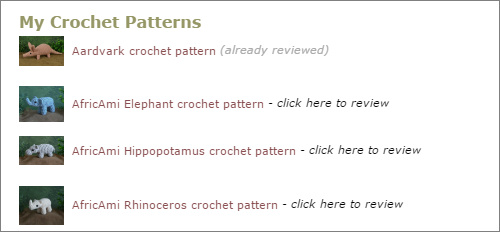
From this page, you can also see which of your patterns you’ve already reviewed, and click straight through to write a review for any of the others. (Useful if you’d like to get some more entries in my monthly Review & Win contest, but can’t remember what you’ve already reviewed!)

PlanetJune shop: new features - options

This page is available in 2 versions: Full and Lite. The Full version is easy to browse because it includes a little photo of each pattern, but if you’ve bought a lot of patterns, all those thumbnails may take a while to load. So, I’ve also given you the option of the Lite text-only version, which loads in no time.

PlanetJune shop: My Patterns (Lite) feature

And now onto the last new feature:

Patterns I Don’t Own

I love this new feature! It’ll be especially useful to those of you who’ve bought lots of my patterns – with so many in my catalogue now, it can be hard to keep track of which you’ve bought, especially as you may have bought something in several different ways: individually; as part of a multipack; or as an optional add-on. The last thing I’d want to do is to make you accidentally buy the same pattern twice, so this list will take care of that.

PlanetJune shop: Still to Buy (Full) feature

If you’re looking for a new PlanetJune pattern to buy, head straight to the Patterns I Don’t Own list (in My Account) and you’ll see an alphabetical list of all the patterns that aren’t in your My Patterns list. Click any pattern name to go to its listing in the shop, so you can add it to your cart (or to your Saved for Later).

Again, this list is available in Full and Lite versions, so you can stick to text-only if you’re on a slow internet connection or just want to check for a specific pattern, or enjoy browsing the photos in the Full version if you have a minute to wait for all the thumbnails to load!

PlanetJune shop: Still to Buy (Lite) feature


These updates are the result of a month of development and hand-coding. Although I’ve tested everything extensively, there’s always a chance that something on the live site may give an unexpected result. If you have any problems using the shop or your PlanetJune account, or see anything that looks remotely strange, please email me to let me know, so I can fix it!

I hope you’ll find the new features helpful, and, while you may not notice all the other little changes and improvements, they should all combine to make the shop, and your PlanetJune account, easier to use from now on.

Comments (6)

September update

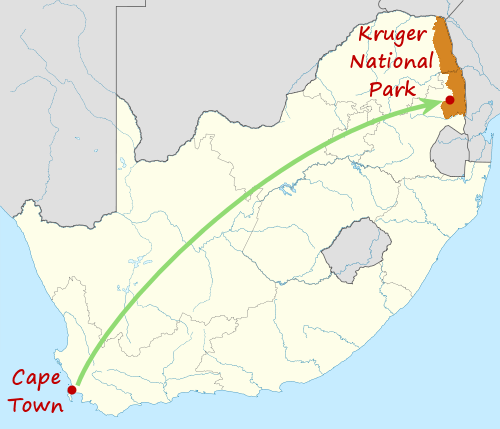
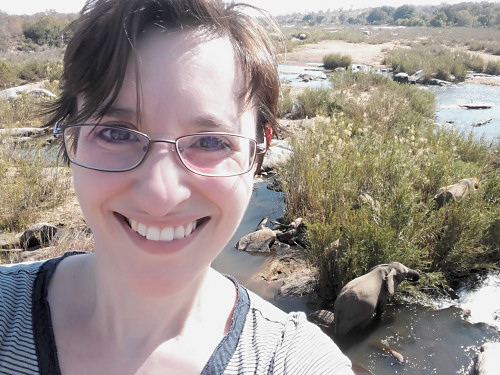
This September update feels very much like a re-run of 2 years ago: I’m back from travels (this time, an amazing safari experience – pics soon! – and a far-too-brief trip home to Canada); I caught a cold on the way home which has turned into bronchitis; and I’ve been working on some big technical improvements for the shop.

But I learnt a valuable lesson in 2014 when all that left me completely burnt out, so I was prepared this time: my autumn and Christmas designs are well underway already 🙂

Shop Updates!

There’ll be a little downtime in my shop tomorrow while I install the updates I’ve been working on for the past month. I’ve planned it for my morning, so it’ll be the middle of the night tonight for most of you in North America. I anticipate it’ll take no more than a couple of hours, but if you go to my shop and see the Maintenance Lemming is still working on it, that means the updates are still in progress!

PlanetJune Maintenance Lemming :)

I’ll explain all the improvements to the shop in a separate post once my updates are complete – I’m very excited for the new features I’ve been developing, and I think they’ll add a lot to your PlanetJune experience. More on that tomorrow, once I’ve finished the upgrades…

Fall CAL

September brings the start of a new season, and the start of a new crochet-along in the PlanetJune Ravelry group! Join us for this relaxed crochet-along that runs from now until Halloween. You can make any PlanetJune patterns (or patterns from either of my books) that fit the Fall theme. Here’s a selection of pattern ideas:

a selection of Fall-themed PlanetJune patterns

And I’m working on a brand new pattern that’ll fit nicely with this theme too, so look out for that in the coming weeks…

Review and Win contest

You’re automatically entered in the next monthly draw every time you write a review for a PlanetJune pattern you’ve enjoyed – and you’ll also be helping future customers make an informed decision about patterns they are considering buying.

I have 2 months’ winners to announce today:

Dinosaurs Set 3 crochet patterns by PlanetJuneDinosaurs Set 3X crochet patterns by PlanetJune
July’s winner is Peggy G‘s review of my Dinosaurs Sets 3 & 3X patterns:

Both of these sets are fantastic!! I have made all 6 dinosaurs now. The Panoplosaurus and the Ankylosaurus take the most time and are the most advanced, but I wouldn’t call them “difficult.” Just take more time and patience. However, they turn out so awesome that it’s worth it. My favorite ended up being the Protoceratops. I love the way his head fin is constructed. He’s very simple, but looks fantastic. Highly recommend all of June’s dino patterns.

Sea Otter crochet pattern by PlanetJune
And August’s winner is Verna H‘s review of my Sea Otter pattern:

I made this Sea Otter for my sister. June’s pattern is the most natural looking otter pattern by far. Her instructions are very easy to understand. My sister just loves it!

Congratulations, Peggy and Verna – I’ve emailed you both to find out which pattern you’d like as your prize!

Comments (2)

Review: Fauxchet

I’m always interested to see and try new innovations in yarncrafting, so when I heard about Fauxchet, I was intrigued. Billed as ‘a new way to crochet’, fauxcheting uses a special tool in place of a crochet hook. Just as knooking is the process of forming actual knit stitches with a modified crochet hook (see my review of The Knook here), the Fauxchet easyloop tool forms actual crochet stitches using a completely different method.

Fauxchet Easyloop Yarn Tool review
(If you have a knitting machine you may recognise the special tool as a stitch transfer tool for making cables etc, but this is a clever repurposing.)

Now, as a crocheter, you may be wondering why on earth you’d want to do this! I wondered the same, which is why I was eager to test out this tool for myself and see if it offers anything new and different from standard crochet.

After trying it out, the main benefits I see are that:

  1. It’s very easy to learn, as there’s just one movement: pushing the tool into the work, grabbing the loop with your other hand, then pulling the tool back out. I think this would make it a fun entry into yarncrafting for children and non-crocheters.
  2. It uses completely different muscles and movements from crochet. If you have problems with mobility or pain in your hands or wrists, Fauxchet could be a good solution. You don’t need to tension the yarn, as the stitch size is controlled by the size of the loops you form by pushing the tool into the fabric – the further you push the tool, the larger your stitch. You don’t need to rotate the tool at all, and the only motions are pushing/pulling with your dominant hand, and pinching/releasing with the thumb and forefinger of your other hand.
  3. As you’ll see below, I love the fabric that it forms!

My Experience

I started out by trying all the basic stitches (chain, slip stitch in back and both loops, single crochet in back and both loops). Although there is a slight learning curve, I found that I could form nice even stitches within a couple of rows of my sample:

Fauxchet Easyloop Yarn Tool review

Prior crochet experience is not at all necessary, as Fauxchet is worked completely differently. The back of the fabric faces you while you crochet, and you work left-to-right across your fabric (right-to-left for left-handers!), so it doesn’t feel at all like crocheting.

You thread the end of the yarn through the eye at the front of the tool before you begin:

Fauxchet Easyloop Yarn Tool review

Then, instead of building up loops on your hook as you form each stitch, you grip the loops with the thumb and forefinger of your non-dominant hand. This sounds like it may be a bit tricky, but is very simple once you’ve practiced for a few minutes.

The basic Fauxchet motion is very simple: your dominant hand pushes the tip of the tool into a stitch, then pulls it back out again, while your other hand pinches the loop that’s formed between thumb and forefinger. Those are the only motions involved! Take a look:

Insert the tool into a stitch:
Fauxchet Easyloop Yarn Tool review

Grip the loop with your other hand, then withdraw the tool:
Fauxchet Easyloop Yarn Tool review

Note: I’m left-handed, and these photos are not intended as a tutorial – just to give you a basic idea of the very simple technique.

I highly recommend you watch the video demos on the Fauxchet site to see how easy the stitches are in practice, with the instruction book to hand as well. Although the instruction book does explain the stitches step-by-step, it makes them sound more complicated than they actually are (e.g. inserting your hook into the next stitch and through the loop you’re holding is accomplished in one easy movement, but it’s split into two steps in the instructions).

My experience was also complicated by the fact that there are no left-handed instructions (in the books or the videos) so I had to constantly reverse all the directions. But as the stitches are so simple – as you’ll see if you watch the videos – it wasn’t too difficult to swap every ‘left’ and ‘right’ in the instructions.

My Fauxchet tip is to make the starting chain extremely loosely. In fact, if you’re fairly new to fauxchet, I recommend you make the first few rows (or a swatch) to get your tension even, then unravel it all and start again with the same yarn once you’ve got into the rhythm.

I found the process of ‘fauxcheting’ very soothing once I got into the rhythm. It made a nice change from crocheting and knitting, and the fabric formed is so loose and drapey that it looks very pretty, even with using only the simplest crochet stitches.

Fauxchet vs Crochet

Although Fauxchet does produce actual crochet stitches, it’s far more limited than a crochet hook. As there’s no mechanism for a yarn over, you can only use it to make short stitches: chain, slip stitch, single crochet, and loop stitch (although, by working into back, front or both loops, that still allows for a range of results). And, just as with crochet, you can make combination stitches from the basic stitches (sc clusters, picots, etc).

I compared a swatch of normal crochet with my Fauxcheted swatch and learnt a few things:

  1. Working with worsted weight yarn, the Fauxchet tool gave me the same gauge as crocheting with a size M (9mm) crochet hook. That’s a lot larger than you’d usually use with ww yarn!
  2. The fauxchet stitches are twisted compared with standard single crochet stitches (see photo comparison, below) – possibly why the stitch is called ‘single Fauxchet’ instead of ‘single crochet’ in the instructions, as they aren’t exactly the same stitch.
  3. Fauxcheted fabric is both drapier and less gappy than the equivalent crocheted fabric made with the same yarn to the same gauge. With my M hook, the crochet feels more like knots and spaces, while Fauxchet stitches feel looser and give more even coverage. I have a theory for this: I suspect that using an extra-large hook forces big holes into your fabric, thus pulling the previous stitches into knots, whereas the slim Fauxchet needle doesn’t disturb the previous stitches, keeping the fabric more regular.

Fauxchet Easyloop Yarn Tool review
Fauxchet vs crochet – look at the blue ‘V’ shapes and you’ll see the fauxchet Vs are twisted at the bottom compared with the crochet Vs.

While the large size of the Fauxchet stitches means that it’s unsuitable for making amigurumi (where the whole point is to make small stitches so you produce a stiff, well-shaped fabric), it is ideally suited for making wearable accessories, as the gauge is so loose that your stitches will have beautiful drape with no effort on your part!

Fauxchet In Practice

My favourite stitch from my swatch was the ‘ridged single Fauxchet’, which is the equivalent of front loop only twisted single crochet (but much easier than that name makes it sound!)

I love the look of the fabric this stitch makes, so I thought I’d try making a quick ridged single Fauxchet scarf in a bulky chainette bamboo yarn I had in my stash. The yarn is lovely and soft, but although it’s labelled DK it’s on the heavy end of bulky, and it’s been too heavy for me to crochet with (giant chunky stitches aren’t my style). Here’s the resulting scarf:

Fauxchet Easyloop Yarn Tool review

The fabric is even and not at all stiff. I’m very impressed with how it looks:

Fauxchet Easyloop Yarn Tool review

Fauxchet on Canvas

I was excited to see that you can also use Fauxchet to make rugs. It’s much faster than latch hooking, because you make loop stitches into the rug canvas directly from the ball of yarn, instead of tying on individual strands of yarn. The end result is a loopy rug, or you can cut the loops if you’d like a more conventional shag rug.

I did have a little play with the loop stitches, but I didn’t quite get the hang of it – I won’t even show you my swatch, because it’s too embarrassing. Every time I pulled a knot tight to lock a loop in place, I shrank the loop at the same time… I think my problem is that the motion uses your non-dominant hand, and I’m not very skilled with my right hand!

I can see from the videos that it’s possible to do it correctly and consistently, so I’d just need some more practice before attempting a rug. While there definitely is a learning curve to this technique, if you persevered and got the hang of it, it’d be a lot faster and less fiddly than conventional latch hooking.

Fauxchet: My Verdict

Pros:

  • Easy to learn
  • Different (and small) movements may be useful for those suffering from hand and wrist problems
  • Makes fabric with beautiful drape

Cons:

  • Limited range of stitches (chain, slip stitch, twisted single crochet, loop stitch)
  • The Fauxchet tool is only intended for use with worsted and bulky weight yarn
  • As the yarn is threaded through the tool, the tool is locked into the project until you finish an entire ball of yarn or cut the yarn
  • Working backwards and using such a different gauge means you can’t easily follow a standard crochet pattern

So, is Fauxchet a replacement for crochet? No, definitely not – and nobody is claiming that it is. But it does have its own advantages, and I’ll definitely be keeping my Fauxchet tool in my craft collection.

I think that making a fauxcheted blanket would be a good relaxing long-term project that’d give me a nice soothing break from the other crafts I enjoy. From my experience with my swatches and scarf, I already know that the end result will have beautiful drape and no excess bulk or holes, which are perfect properties for a blanket, so I’m looking forward to the slow meditative process of push/pull, grip/release and watching the rows slowly grow.

Where to Buy

If you’d like to try the Fauxchet tool, you can buy it from Amazon (it’s very inexpensive!), and I recommend you watch the free videos and try some of the free patterns from the Fauxchet site. If you enjoy fauxcheting, you can buy downloadable patterns and ebooks from Amazon (or direct from LeisureArts).

Comments (9)

Hawaii wildlife

The natural world is amazing and varied, and there’s nothing like seeing parts of it first-hand, but I hope my photos will give you a small taste of that excitement! Every time I’m lucky enough to travel, it fills me with new inspiration and appreciation for nature.

June and sea turtle in Hawaii
Me with a green sea turtle – an overwhelming dream-come-true experience

I didn’t think I’d ever be able to top the thrill of seeing orangutans in their native environment of Borneo, but my sea turtle-spotting adventure in Hawaii last month may have just done it!

I took over 3000 photos on this trip and couldn’t force myself to narrow it down to just a dozen of the best. Instead, I’ve set up a few themed galleries in this post (scenery, turtles, lizards, misc wildlife) so you can enjoy any subjects that interest you without being bored by the rest 🙂

Read the rest of this entry »

Comments (6)

Summer Days Sunhat crochet pattern

I designed this hat last Christmas (i.e. my southern hemisphere summer) to meet a specific need: to keep the sun out of my eyes while I’m out walking without worrying that my hat would blow off my head! And so, after several refinements, the Summer Days Sunhat was born:

Summer Days Sunhat crochet pattern by PlanetJune

This hat is a cross between a practical bucket hat and a stylish cloche. Well-fitting sides mean the hat won’t blow off your head in windy weather, and the brim has a solid stitch pattern that will keep the sun out of your eyes.

This is an easy-care, easy-wear hat: it doesn’t need blocking and doesn’t have a starched brim, so it’s easy to throw in a bag when you aren’t wearing it without needing to worry about crushing it!

I designed the no-gauge pattern to work for any size head (from a small child to a large adult) and any size yarn (although I like it best in fingering/sport weight so it’s light and elegant). Just measure your head and then follow the simple instructions. You’ll need a calculator to do a single sum to get started, then all you need is a measuring tape so you’ll know when you’ve reached the right size.
Summer Days Sunhat crochet pattern by PlanetJune

The brim has two options – the floppier, all-yarn version (pictured above), and a version that incorporates fishing line to add a little stiffness while leaving the hat foldable but not crushable (pictured below).
Summer Days Sunhat crochet pattern by PlanetJune

My sample hats have already seen me through a South African summer and a Hawaiian vacation, without once blowing away in the wind, and they still look as good as new!

I made the pink and natural coloured ones from a local 4-ply (fingering weight) mercerized cotton yarn – Elle Premier – but I wanted to show a sample made in a more readily-available yarn. I used Patons Grace to make my purple hat, and, although it’s called sport weight, it has exactly the same weight and yardage per ball, so it’s a pretty good match.

Links and Launch Discount

If you’re ready to try crocheting your own Summer Days Sunhat, you can buy it individually from my shop, or as part of a Custom Set of any 3 PlanetJune Accessories patterns of your choice.

PlanetJune Accessories crochet patterns by PlanetJune

And, for this week only, save 50c on the Summer Days Sunhat pattern by using discount code SUMMER at checkout. (Valid until Sunday 17th July 2016.)

Tip: The discount is valid on the Sunhat alone and the Custom Set including the Sunhat – so you can save even more by buying the multipack deal with the discount!

Or, if you’re not ready to buy just yet, please heart or queue it on Ravelry so you don’t forget about it:

I hope you’ll enjoy this pattern! If you make one, please take a photo of you wearing it, and share it in the PJ ravelry group or on my Facebook page, or tag me on Twitter or Instagram (@PlanetJune) so I can see it 🙂

Comments (3)

July update

I was hoping to be able to show you my wildlife photos from Hawaii by now, but with several thousand to go through, I’ve only been able to narrow them down to about 100 so far. I’ll try to edit that down to a more manageable number soon, so I can get the best photos posted (sea turtles!!!) for you to enjoy 🙂

Review and Win contest

You’re automatically entered in the next monthly draw every time you write a review for a PlanetJune pattern you’ve enjoyed – and you’ll also be helping future customers make an informed decision about patterns they are considering buying.

I was in Hawaii last month, so I have 2 winners to announce today:

Pansies crochet pattern by PlanetJune
May’s winner is Judy C‘s review of my Pansies pattern:

Another wonderful and fun plant pattern from Planet June! I’ve made both basket sizes and almost a dozen pins. All instructions are clear and well illustrated. The pansy flower is a bit tricky at first, but once you have done one or two, it is easy. Clever design minimizes having to sew on a bunch of different leaves. Highly recommend.

African Violets crochet pattern by PlanetJune
And June’s winner is Melissa J‘s review of my African Violets pattern:

I made one of the large versions for my mother in law after she killed the real violet I gave her years ago. She absolutely loved it! I am an advanced beginner with crochet, and I found the pattern very easy to follow. All the stitches are very basic, but it comes out looking so amazing and impressive in the end!

Congratulations, Judy and Melissa – I’ve emailed you both to find out which pattern you’d like as your prize!

What’s Next?

I’ll have a summery-themed PlanetJune Accessories pattern to launch shortly, and then I’ll be taking a break from pattern releases for a while, while I work on some big projects to launch in the fall.

And Happy Canada Day to all my fellow Canadians! I’m with you in spirit, if not in body 🙂

Comments

A Colour Changing Crochet Investigation

managing yarns when changing colours tutorial

Spoiler alert: in doing this colour changing investigation, I’ve come up with recommendations for how best to manage your yarns when you make multiple-colour amigurumi.

If you’re not interested in my experiments and how I reached my conclusions, you can skip the rest of this post, and jump straight to the Changing Colour: Managing the Yarns tutorial 🙂


I’m often asked how to deal with the other yarn when changing colour in my amigurumi patterns. If there’s a specific technique I recommend for a specific pattern – one that makes the colour changes much neater or faster than any alternative – I give you that information in the pattern itself.

But, in general, I don’t give specific details within a pattern for every colour change, because a) there’s no one ‘right’ way to deal with yarn ends and carrying colours, and b) it’s up to you which method(s) you find to be the best combination of fast, easy, and with a good end result.

In fact, I tend to intuitively use a combination of several options, but how do you know what to use when? Time for another crochet experiment, so we can see the the advantages and disadvantages of each technique, and I can give you a better recommendation…

Note: Not interested in the investigation and just want my recommendations for how to deal with the other yarn when you’re changing colours? Go straight to my page Changing Colour: Managing the Yarns!

Method

I crocheted the same amigurumi-style sample piece 4 times, using the same pattern each time but changing the method for dealing with the other yarn in each sample, as a basis for comparison.

colour_changing_investigation

The pattern was a two-colour cylinder worked in a continuous spiral in the round, changing colour every five stitches on one side and every two stitches on the other side, so we can see any differences between short and long blocks of stitches between colour changes.

The techniques I used were:

  • 1. Cut-and-tie: Cut the yarn at every colour change and tie each resulting pair of ends together.
  • 2. Stranding: Carry a float of yarn behind the work, and pick it back up when you resume crocheting with that colour.
  • 3. Tapestry crochet (yarn on top): Lay the unused yarn across the top of the stitches, and crochet around it with every stitch.
  • 4. Tapestry crochet (yarn behind): I don’t think there’s a real name for this technique: crocheting around the other yarn with each stitch, but holding it behind the back loop, instead of across the top, of the stitch below. (But does that really make a difference? Let’s find out…)

Results

The overview picture below shows the results of the four different methods.
L-R for each method:

  • Wide blocks of colour, right side
  • Wide blocks of colour, wrong side
  • Narrow blocks of colour, right side
  • Narrow blocks of colour, wrong side

colour changing experiment by PlanetJune - 4 methods to deal with yarn ends when changing colour in amigurumi

(You may be wondering why I’m looking at the wrong sides too, when the inside will never be seen in an amigurumi piece. It’s important for the experiment to see what’s going on behind the scenes as well as comparing the look of the finished outside.)

By comparing each of these samples, I could see the advantages and disadvantages of each method, which will let me figure out which is best to use when, and why…

Cut-and-tie vs Stranding

Stranding is much faster than stopping to cut the yarn and tie knots at every colour change, but the quality of the stranded result depends on the width of the yarn that’s floated on the back of the piece:

colour changing experiment by PlanetJune - cutting vs stranding

For long stretches between colour changes, the floated yarn on the back of the piece can distort the shape of your work (if too tight), or cause the stitch before and after to work loose (if too loose). Cut-and-tie leaves yarn ends, but gives a consistent result.

However, for frequent colour changes of only a stitch or two, cut-and-tie is fiddly and leaves a big mess of ends on the inside of the piece. Stranding works very well for these shorter colour changes, provided you tension the stranded yarn so it sits snugly along the inside of the piece.

Conclusion: Stranding the yarn behind your stitches saves time and yarn vs cutting and tying at each colour change, but it works best when you’re only carrying the yarn for a short length before swapping back.

Tapestry crochet vs Normal crochet (cut or stranded)

There’s a big problem with using tapestry crochet for amigurumi – unless, of course, the pattern was designed to be worked this way! Let’s compare the stitches formed with standard crochet vs those with tapestry crochet:

colour changing experiment by PlanetJune - stitch bias difference between normal and tapestry crochet

Working in the round without turning always introduces a bias to your stitches – a stacked colour change will travel by approximately 1 stitch per 5 rounds (above, right). But with tapestry crochet (above, left), that bias is intensified, so a stacked colour changed will travel by approximately 1 stitch per 2 rounds. So, if you use the tapestry technique where it’s not intended (or, use non-tapestry for a pattern designed for tapestry), the colour pattern will become skewed.

The tapestry stitches are also slightly taller than standard stitches, but I’m not sure there’s enough of a difference there to skew the overall shaping significantly on the scale of an amigurumi piece. The colour shifting is a much more obvious problem, and a good enough reason to abandon this method for amigurumi colour changes without further investigation.

Conclusion: Don’t use tapestry crochet (working over the carried yarn with every stitch) for amigurumi with colour changes, unless the pattern specifies it.

Tapestry crochet (yarn on top vs yarn behind)

The modified tapestry crochet technique, where you carry the yarn just behind the back loop of the stitch instead of across the top, does make a difference: looking at the green stitches in the samples below, you can see that the carried (pink) yarn is less visible on the front of the piece, and more visible on the back (where it doesn’t matter for amigurumi).

colour changing experiment by PlanetJune - comparison of tapestry crochet with the yarn held on top or behind the stitches

Conclusion: If you’re going to work over yarn (to carry a yarn, to catch a floated yarn, or to work over a yarn end), for amigurumi it’s better to hold the yarn behind the back loop of your stitch instead of across the top of the stitch.

(This modification doesn’t help with the bias effect, so I still wouldn’t use it for amigurumi colourwork, unless the pattern was designed to be worked in tapestry crochet. But I have incorporated this technique into my recommendations in a specific scenario, as you’ll see…)

Verdict & Recommendations

managing yarns when changing colours tutorial

Putting it all together, we can see which techniques may be most effective when a pattern has frequent/infrequent colour changes that span few/many stitches, and I now have solid reasons for recommending different yarn-wrangling methods in different situations.

You always have a choice of how to deal with the other yarn(s) when you change colour, but I’ll give you my recommendations – together with some case studies so you can see how these methods work in practice for amigurumi – in my tutorial page:

Continue to ‘Changing Colour: Managing the Yarns’ >>

Comments (7)

    navigation: arrow

    buy crochet patterns and accessories from my online store

    'Everyday Crochet' and 'The Essential Guide to Amigurumi' crochet books by June Gilbank

    Crochet video tutorials and step-by-step photo tutorials

    Free PlanetJune crochet patterns

    Frequently Asked Questions

    navigation: arrow

    Punchneedle Embroidery information, ebook & patterns

    Papercraft ebook & tutorials

    Free PlanetJune craft projects & tutorials

    Ravellenic Games: Team PlanetJune
    PlanetJune Reindeer Games
    PlanetJune Temperature Snake CAL

    June Gilbank

    Hi, I'm June. Welcome to my world of nature-inspired crochet and crafting. I hope you enjoy your visit!

    If you'd like to get in touch, you can contact me here.
    crocheted Canadian flag by PlanetJune
    Proudly made in Canada!
    A fanned-out pile of the books Everyday Crochet and The Essential Guide to Amigurumi, with text 'The answers to all your crochet questions at your fingertips - find out more'

    Want to say thanks? You can send me money in seconds at paypal.me/planetjune (over $20) or paypal.me/planetjune2 (under $20) or send me a donation through my shop.

    Or simply click through from my links before you shop at Amazon, Etsy, KnitPicks, LoveCrafts and more, and I'll make a small commission on your purchase, at no cost to you! Start here:

    ♥ Support PlanetJune ♥

    Tip: This link is also in the footer of every page!

    Thank you so much for your support!