
How to Crochet an Invisible Decrease
After the magic ring, what’s the one other technique you need if you want to create beautifully finished amigurumi? The invisible decrease (abbreviated invdec) – it’s absolutely invaluable.
What is an Invisible Decrease?
The invisible decrease (invdec) really is as good as its name claims – it’s almost impossible to see, even if you’re looking for it! You’ll have no more bumpy or gappy decreases once you’ve mastered this technique – all your stitches will look smooth and even.
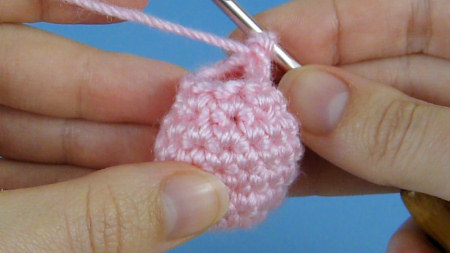
Standard decreasing methods (sc2tog or skipping stitches) leave a bump or gap when you decrease. The invisible decrease (invdec) method is different: it’s practically invisible, even if you know what you’re looking for! (See my blog post for a comparison of the three methods.)
Why does it work so well? The magic behind the invdec is that it groups the previous stitches together at its base, so the stitch itself looks identical to a regular single crochet.
The invisible decrease method will probably take a few attempts to master, but, just like the magic ring, it’s one of those techniques that’s so good, you’ll wonder how you ever crocheted without it!
I recommend you watch the video to see the method in action, but in case you prefer text or want something visual to refer to, I’ve also made a photo tutorial version for you.
Quick finder:
- Video Tutorial (right- and left-handed)
- Invisible Decrease Tips
- When to Use Invisible Decreases
- Step-by-Step Instructions (right-handed)
- Step-by-Step Instructions (left-handed)
Invisible Decrease for Amigurumi – Video (right-handed)
Click to watch this video on YouTube.
Invisible Decrease for Amigurumi – Video (left-handed)
Click to watch this video on YouTube.
Note: The videos may look a little small embedded in the blog: if so, you can fullscreen them or click through to YouTube to watch them full-sized 🙂
Invisible Decrease Tips
Invdec is a little tricky to get the hang of, and there are two points during the decrease where you can accidentally lengthen your stitch so it isn’t neat and tight, and the resulting decrease will be far more obvious.
I’ll demonstrate these invdec problem points, so you know where the pitfalls are, and how to avoid them. You’ll find this tutorial useful if:
- You’re new to the invisible decrease technique (watch my video tutorial before you continue reading this!)
- You’ve tried invdec but been disappointed by your results
- Your invdecs look inconsistent, gappy, or too prominent
- You want your amigurumi to look as good as possible!
A Note about Tension
Although maintaining consistent tension on your yarn is a skill you need to master in order to crochet anything beautifully, it’s vitally important for amigurumi, as you need your stitches to be tight and even to produce the regular, firm amigurumi fabric that allows us to create complex ami shaping, and hides your stuffing. I’ve seen some people recommend that you tug on your yarn after every stitch to tighten it up, but that isn’t necessary if you maintain consistent tension.
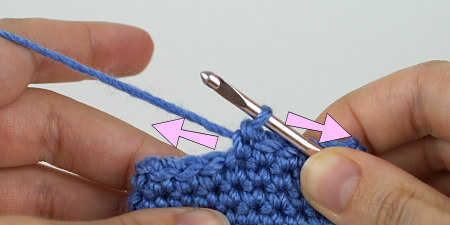
Tensioning your yarn is a balance between the hook pulling forward and your other hand pulling backward.
How do you do that? Well, while your hook is pulling the yarn forward, your non-hook hand is simultaneously pulling back on the yarn, so you use a controlled amount of yarn to form each stitch. (You probably do this without even realising you’re doing it; if the yarn could just slide freely through your fingers with no tension, your hook would pull up large, inconsistent loops, and your crochet would look sloppy.)
When I talk below about pulling back on the yarn so the working loop is tight around your hook, the goal is to bring the tension back to your standard level, so the working loop should be the same size and tightness as it is for all your other stitches. If you go too far and pull it extra-tight, you’ll just make it more difficult to work back into that stitch in the following round.
Perfecting the invdec
If you look at the top of an invdec stitch, you’ll see there’s a ‘V’ at either side of the decrease. (As invisible decreases are practically indistinguishable from the surrounding stitches, I’ve crocheted my samples with the invdecs and the surrounding top loops in a different colour, so you can see what I’m talking about!)
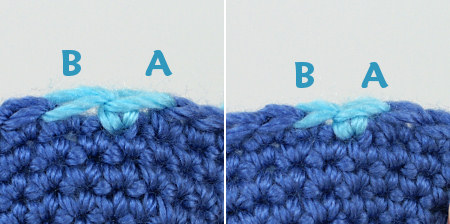
Left: The source of the problems is these extra-long Vs at the top of the stitches surrounding the invdec.
Right: Invdec done correctly, with the Vs the same length as in the surrounding stitches.
These two Vs (A and B) are the culprits – if either or both of these is lengthened, there’ll be extra space around the invdec and it can look gappy or sloppy.
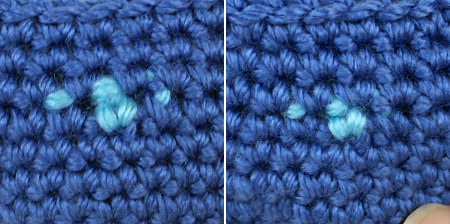
Left: The lengthened Vs have left a larger gap at either side of the invdec.
Right: Invdec is indistinguishable from the surrounding stitches (except for my helpful colour change!)
Loop A
Checkpoint: When you begin an invdec stitch, as you’re swinging the hook around to get the tip through both front loops, the working loop (the one that was already on your hook before you started the stitch) tends to loosen up.
Fix this: Once you’ve inserted your hook under the two front loops, and before you yarn over, tug the yarn to make sure the working loop is still tight on your hook and hasn’t lengthened.
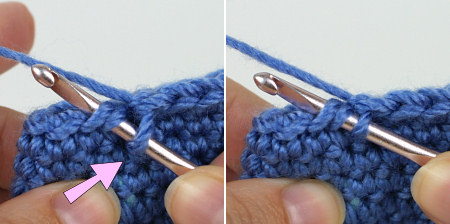
Left: Lengthened working loop on hook will cause a loose stitch.
Right: Tightened loop – perfect!
Loop B
Checkpoint: After you complete the invdec, you’ve just turned 2 stitches into 1 stitch, and your hook is now further back than it usually would be for starting a new stitch. So this is another point where your yarn can make an extra-long loop, as you bring your hook forward over that extra distance to begin the next stitch.
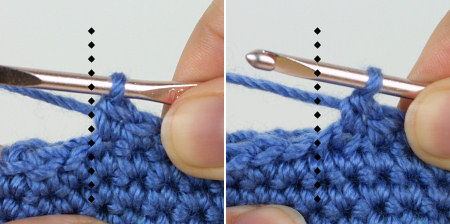
Left: The position of the hook after a sc stitch.
Right: After an invdec, the hook is further back (dotted line marks the usual position), so there’s a greater distance to reach the next stitch.
Fix this: Make sure you keep tension on your yarn, so the loop on your hook doesn’t stretch out as you insert your hook into the stitch after the invdec. (If, after inserting your hook to begin the next stitch, you see the working loop has lengthened, just pull the yarn so the working loop is tight around your hook again, before you yarn over and continue with the stitch.)
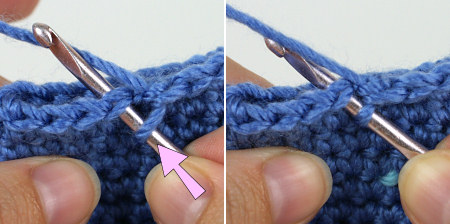
Left: Lengthened working loop after inserting hook into next stitch.
Right: Tightened loop – perfect!
Multiple Decreases
The potential problem is doubled when you’re working 2 invdecs in a row, as you have the ‘too far back’ effect (Checkpoint B) and the ‘swinging the hook’ effect (Checkpoint A) both acting on the same loop, so you should make a little extra effort to be conscious of the size of the loop on your hook, and make sure it stays tight and doesn’t lengthen.
Invisible Decrease Perfected!
With a little extra effort to make sure you’re maintaining consistent tension, even while you decrease, your stitches will all stay the same size, and your invdecs will be as invisible as advertised!
When to Use Invisible Decreases
In addition to the obvious use in amigurumi, you can also use the invisible decrease for any piece worked in single crochet, in the round, without turning (e.g. hats).
As each invdec leaves two unworked loops visible from the reverse side, you won’t want to use it for anything where you turn between rows/rounds, or where both sides will be on display.
For projects like amigurumi and hats, the backs of the stitches are always hidden on the inside, so the unworked loops won’t show from the front of the finished pieces, and all you see is smooth and even decreases.
Invisible Decrease – Step-by-Step Instructions (right-handed)
Starting position (below, left). Insert the hook into the front loop of the first stitch (2 loops on hook, below, right). DO NOT YARN OVER.
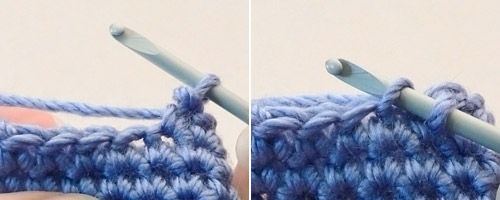
Insert the hook into the front loop of the next stitch. To do this, you’ll need to first swing the hook down (below, left) so you can insert the hook under the front loop (3 loops on hook, below, right).
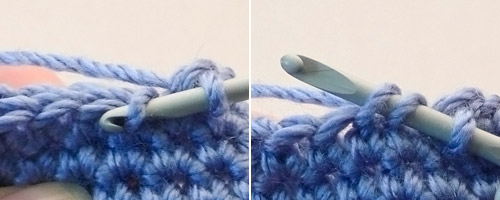
Yarn over and draw through the first two loops on the hook (2 loops on hook, below, left). Yarn over and draw through both loops on the hook (invdec completed, below, right).
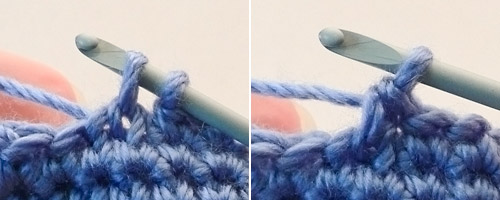
Now let’s play a game: spot the decrease…
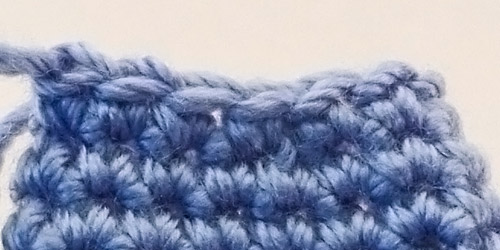
Good, huh? Give it a go with your next ami – I promise you won’t regret it…
Invisible Decrease – Step-by-Step Instructions (left-handed)
Starting position (below, left). Insert the hook into the front loop of the first stitch (2 loops on hook, below, right). DO NOT YARN OVER.
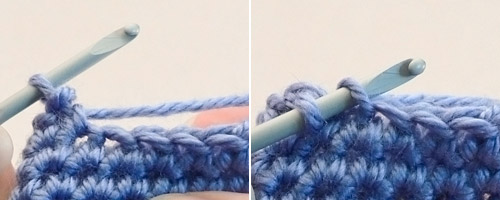
Insert the hook into the front loop of the next stitch. To do this, you’ll first need to swing the hook down (below, left) so you can insert the hook under the front loop (3 loops on hook, below, right).
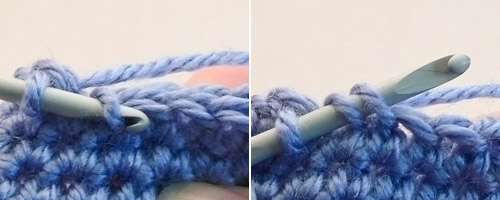
Yarn over and draw through the first two loops on the hook (2 loops on hook, below, left). Yarn over and draw through both loops on the hook (invdec completed, below, right).
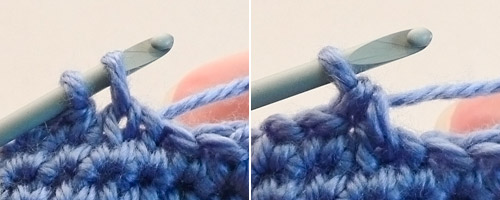
Now let’s play a game: spot the decrease…
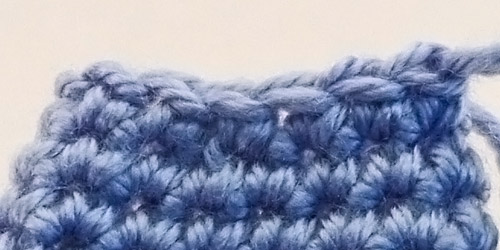
Good, huh? Give it a go with your next ami – I promise you won’t regret it…

Loved this tutorial? I have so many more amigurumi tips and tricks to share with you!
Boost your amigurumi skills with my latest book, The Essential Guide to Amigurumi, your comprehensive guide to amigurumi techniques and tips.
Do you find my tutorials helpful? If so, please consider making a contribution towards my time so I can continue to create clear and concise tutorials for you:
Thank you so much for your support! Now click below for loads more crochet video and photo tutorials (and do let me know what else you’d like me to cover in future tutorials…)

















Tania said
I found this helpful morsel via crochetme from Kim Werker….thanks so much! I am going to try this out for my next project. It looks terrific.
OT….what is the best yarn to use for amigurumis? I love that yarn you are using above..and I have only used yarns I have on hand..as I have to budget. If you need to point me in the right direction to read more on that, that’d be fabulous. 🙂
June said
Hi Tania, I don’t use any ‘special’ (i.e. expensive) yarns for my amigurumi. Most amigurumi are made with worsted weight yarn. I like the ‘soft’ acrylics best; you can find them in any big craft store and they aren’t too expensive (especially if you have a coupon, or wait for a sale): Bernat Satin, Red Heart Soft and Caron Simply Soft all have that nice sheen to them, are nice and soft to work with, and make very pretty amigurumi.
The other yarn I like, even though doesn’t have that sheen or softness (although it’s still softer than traditional ‘cheap & nasty’ acrylics) is Lion Brand Vanna’s Choice. It comes in amazing colours and it’s a little thicker than other worsted weight yarns, which makes for a good firm structure. You can see the difference if you compare, say, my AmiDogs (Bernat Satin) with my Dinosaurs (Vanna’s Choice).
I’ve just written a whole book of amigurumi information like this; if you’re interested, it’s called The Complete Idiot’s Guide to Amigurumi 🙂
Jessica said
This is a revelation – thank you so much June! My amigurumis will all be done using this technique now 🙂
Frida said
I LOVE YOU! Thank you for helping me with something that will make my amigurumis beautiful so that I won’t ever get tired of them looking awkward!
You just saved the Fridagurumi species! ?
Leah said
When I read an internet blip somewhere that said ‘invisible decrease for amigurumi’ I thought Yeah! Right! We will see about that! (I am a natural skeptic btw) I do have to admit, you have done it. This is great. I have always disliked the way the traditional decreases look and this definatly solves that. And thanks for posting the left handed version (I do get tired of having to look at things backwards). Thank you for proving my sarcastic, snide comments wrong! Now I just have to go back and rip appart and redo all the Amigurumi I have made before learning your technique.
Nata said
This method is amazing – the best ever for making a decrease!! Thanks for sharing with us 🙂
Sally said
Hi June
Thought I was doing something wrong with the invisible decrease, just didn’t look as if it was invisible!!!!
Should of checked your fantastic tutorial sooner ( pictures say a thousand words don’t they)
I now know where I went wrong.
Thanks also for the great designs, here in England were lucky to find ANY crochet patterns,( they’re either 1970s or baby cardigans) never mind up to date ones.
THANKS AGAIN Sally
Ashley said
Wow! That’s pretty incredible! Thanks for sharing! I’ll definitely give it a shot next time =D
allierwill said
Oh, my gosh! I love that you put the pictures in. I’ve seen directions and other tutorials for this technique and couldn’t figure it out. you make it so much less confusing. Thanks!
Shippymolkfred said
Thanks for this great tutorial.
I will test this immediately!
Greetings from Scotland
Schippymolkfred
Ann Byron said
Let me add my thanks too. I also appreciate the clear instructions
Akua said
THANK YOU THANK YOU THANK YOU! Love it. looks so much better on my dolls!
Sonja said
I love you! I just discovered that my past attempts at invisible decrease were wrong-oh so wrong! Now thanks to you, I have seen the light and got it. No stopping me now. Thanks so much.
Tana Goen said
Been crocheting for years, never used the invisible decrease….it is the best thing I have ever learned.
Bibbi said
WoW! That’s great! Thanx a lot!
Inbaliya said
Thanks for a very good tutorial. With your blog, crochet seems easy than ever!
Estella said
Thank you for such a detailed tutorial. You have saved me from so many frustrations. I’ve always hated how you could see the stuffing using the other techniques.
liz shinagawa said
Brilliant…this makes all the difference in the world to the finished look of my work. Thank you for sharing.
Liz
Brandon said
Thanks very much! This problem has been vexing me for weeks; this front-loop decrease technique works beautifully!
Artesanica said
que bueno lo explicas yo no lo sabia hacer y me daba bronca cuando disminuia que queden esos huecos.
Gracias.
Reba said
I am so thankful for this. I’ve always hated the space you can see in the skipping a sc! THANK YOU, THANK YOU, THANK YOU!!!!!
beadfreak said
Loved this and your tut for the magic ring. These are my new new replacements for slip stitch to form a ring and sc2togs!!!!! THANK YOU, THANK YOU, THANK YOU!!!!
pomarrancza said
Thank You soooo much!!!!!!!!!! I hated the decrease loops.
sukigirl said
I had just finished ripping back part of a head on an amigurumi (since I wasn’t happy with the decreases) when I remembered this tutorial.
I tried it and I’m so happy with the difference it makes to my project!
Thanks so much!!!
Jen said
WOW WOW WOW Thanks so much! Pure GENIUS! 😉
June said
Izzy, no it doesn’t mean that 🙂 Crochet in both loops as usual; it’s just the decrease stitches that you make in the front loops. Think of it like this: you’re still going through 2 loops as with a normal stitch; it’s just that the loops are side by side instead of one behind the other: that’s what makes this decrease stitch so invisible.
Izzy said
oh, ok then. does that mean i have to crochet in the front loops for my entire project?
June said
Izzy, when you try it you’ll see it’s actually a lot easier if you go through just the front loops to make this stitch. Flipping the hook down to go up through the second stitch would be pretty difficult to do if you’ve gone through both loops, plus it would make the stitch bulkier and less ‘invisible’!
Izzy said
i was wondering, do you have to put it through the front loop or can you put it through both loops (by it i mean the hook)]
other than that….omg! i always have GIANT holes at the bottom of my projects!! yay!! i can fix that now
Maryangela said
Hi, June!
Thank you so much for this tute. It’s like you’ve changed my life =D
So I’m a linking to your post and hope other people will be as happy as I am after learning how to invisible decrease!
Hazel Furst said
Wow!
curegirl0421 said
Thanks June!! I’m about to get started on a Cthulu (because why not, I ask you) and this will be so handy! Plus, getting through that font loop when it’s down to just a few stitches is so much easier than trying to wrestle into both parts of the stitch…
Of course my gauge is like IRON, so that could just be me. 😉
Bethel King said
Thanks so much for including the left-handed directions as well as the right!
Annessa said
Thanks alot. Just try it out, is so great, no more big and visible holes!!!
Me a leftie, really appreciate extra tutorial for leftie.
XOXO
Izabela said
thank you for this fantastic tutorial, I just can`t believe this is so easy… just used your explanation to do a decrease with double crochet stitches and it looks so much better! great! thanks again!
Krista said
I found your blog yesterday. What a find. 🙂
futuregirl said
This is wonderful! I’m so happy to learn about this technique! Thank you for taking the time to put together such a thorough tutorial for us.
becky said
oh my this is amazing i have been wondering how to hide my decreases, this would also work for when I am making beanies and things.. so amazing
Maryann said
Thanks for the decrease, and THANKS for showing a lefty version! It’s nice not having to reverse the photos in my head.
Samantha said
:O *stares in amazement*
i wish i had known about this when i crocheted my boyfriend a big big heart for valentine’s day! the bottom came out looking like swiss cheese, there were so many decreases! i guess next time it’ll look a lot better 😀
June said
Lola: yep, it’s just a straight substitution. 1 dec/sc2tog = 1 invdec. Easy peasy!
lolagurumi said
Great idea! Look forward to using it
How would you replace this in a pattern written using dec/sc2tog?
Would one invdec equal one of those? Usually I eyeball that kind of stuff, because the pattern direction never turn out nicely. note: i haven’t used one of your patterns yet 😉
Thanks
Lola
eve said
What can I say! GenioUs..
xox
Tirzah said
This is wonderful! Thank you so much!
Aveen said
In all the time I’ve been crocheting I’ve never even heard of this but I really wish I had! I can’t wait to try it out. Thanks 🙂
laughing purple goldfish said
hmmmm…. it all seems a bit too easy really, doesn’t it?
thanks for sharing this method, I’ll certainly be using it from now on… and will be linking to your blog when I do
much appreciated 🙂
Anna said
I love you.
EclatDuSoleil said
Thank you June! A really interesting solution, I make a link from my blog.
Anonymous said
I recently made some hearts using both usual metods, and I wasn’t pleased with results. Then I start looking for something invisible 🙂
Thank you for this!
Sonia said
This is my favorite “aha!” thank you thank you for this great tutorial :o) no more strange loops in my yarny friends (does that word exists? I don´t think so, but I don´t speak English very well, and I like to invent words)
Cheers! :o)
Sonia
Josefin said
Oh, this was easy! I mean, hello! Where have my brain been all this time?!
Thank you for a good tut June, I will do this next time I make an amigurumi! 😀