Craft Blog Shop Mailing List

Archive for Tutorials

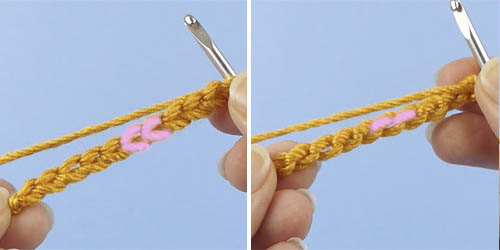
how to crochet an i-cord

Have you ever tried to crochet a really tiny tube or cylinder? I find that single crocheting in a ring with 5 stitches is challenging enough; let alone trying to make a 4-sc cylinder, or, almost impossibly, a 3-sc tube.

Knitters are lucky; they have a great way to make a very fine tube – it’s called an i-cord and it’s really easy to knit up on dpns (if you knit). But I have great news for you: you can also make i-cord using your crochet hook!

how to make a crocheted i-cord by planetjune

It’s very simple once you get the hang of it, and it’s an easy way to make fine tubes, as long as you like. You can use i-cord in amigurumi, as trim, or even to make bag handles. It’s versatile and works up quickly.

Note: you can also make a wider i-cord tube, by starting with more chains and dropping all but one loops off the hook. I’d recommend you don’t go too wide though, as it’s easier to accidentally pull out one of the dropped loops when you have more of them in play. I’d recommend you stick with a 3-ch or 4-ch crocheted i-cord. For anything wider than that, make a sc spiral (or learn to knit it on double pointed needles).

The easiest way to explain it is to show you, so I’ve made a video showing how to crochet an i-cord. And because I’m nice like that, I’ve done right-handed and left-handed versions.

Crochet an i-cord (right-handed)

Crochet an i-cord (left-handed)

See – it’s easy!

If you’d like to practice crocheting i-cord, I’ll have a new pattern that uses this technique available in a few days…

Share

Comments (43)

shoe refashion with beads

I’m filing this as a tutorial because you could use the same methods to add pretty bead embellishments to any pair of shoes!

My sister’s getting married next week and I, being the maid of honour, need to have pretty shoes for the occasion. This is a huge problem for me; I’m not a girly shoe kind of girl, and I’ll go for comfort over style any day: heels hurt my feet, pointed toes hurt my feet, unpadded footbeds hurt my feet… However, I’m not stupid, and I don’t think running shoes would be the right look for this occasion! I thought silver would be best with my purple maid of honour dress, but all the silver shoes I saw looked totally tacky or ridiculously expensive. After a marathon 2.5 hour shopping trip covering 7 shoe shops, there was only one pair that looked nice (i.e. not flip flops), were fairly comfortable (i.e. standing in them for 2 seconds didn’t make me say “ouch!”), and reasonably priced. So we went back to the first store (of course that’s where they were!) to buy them.

shoe refashion

But. Slight problem: on closer inspection, the beading on the shoes was quite nice, apart from a hideous misshapen lump in the middle of each band, surrounded by a border of tacky-as-anything gold seed beads. Why would they do this?! I despaired for a moment and then remembered that I’m crafty and can totally fix stuff like this. I bought the shoes.

shoe refashion
Before. Hideosity.

The beads were stitched on with invisible nylon thread, and the fabric (and hence the threads) were all glued down to the layer below, so I could snip the threads on the offending beads without all the other beads falling off.

shoe refashion
Offending beads removed.

I wanted to replace the focal bead with something that would tie it more closely to my purple dress. I found some flat oval cats eye beads that are subtly purple, without looking out of place on the shoe (some of the existing beads are pinkish so the tones match). I couldn’t glue the focal beads to the shoe because the surface was too uneven and the beads were too slippery, so I used some invisible nylon beading thread to go through the focal bead and through an existing bead on each side to lock it in place. A little superglue on the knot to stop it from coming undone when I snipped off the ends of the thread, and the focal beads were secured.

shoe refashion
Focal beads attached.

Now I just needed to fill the empty space around the new focal beads. I bought some glass seed beads in similar shades to the seed beads already on the shoe, and used some Aleene’s Jewel-It glue (specifically designed for permanently sticking gems onto clothing – I happened to have bought an Aleene’s trial size multipack a couple of years ago, and never had a use for this type of glue until now!) to attach them. I put a bead on the tip of a needle, dipped one side into the glue, and used the needle to position the bead. Then I used a pin to keep the bead in place while I removed the needle, and waited for the glue to dry. Easy, if a little fiddly.

shoe refashion
Seed beads fill the gaps

I love the finished shoes – well, as much as I could love impractical women’s shoes. No idea how I’ll cope with those little heels; I’ll probably trip up the aisle! Wish me luck!

Shoes: $35. Beads: $7.50. Wearing a pair of shoes I actually like to my sister’s wedding: priceless.

shoe refashion

Share

Comments (8)

refashioning an unflattering top

I bought a cute summer top last week. It was very inexpensive, the colour was lovely, the fabric had a nice texture, and it looked like it would be a cool, pretty, summer top.

And then I tried it on. Um…

the original baggy top
Please excuse the bathroom fixtures in these photos – it’s the only place I have to take photos of myself in the mirror!

I don’t know which body types the ‘potato sack’ look would flatter, but it’s certainly not mine. Is it a maternity top? No it’s not – I did check after seeing the fit, or lack thereof! Do I need a smaller size? No – it’s a size XS. Ridiculous.

I thought of returning the top, but then I decided to try a little refashioning instead to see if I could improve it. The fabric doesn’t stretch, so I had to take care not to make it too fitted – I need to be able to get it on and off!

Step 1: Measure for new side seams. I turned the top inside out, tried it on, and pinned new seamlines down each side. I took in about an inch and a half on each side, tapering out a bit at the bottom because I didn’t want it to get too tight around my hips. (Turning the top inside out first lets you pin the new shape while you wear the top, and means that you can stitch directly along your pin lines once you take it off.)

Step 2: Sew new side seams and cut off excess fabric. I stitched along my pinned lines with a straight stitch, and then cut off the excess fabric 1/4″ outside my new seams. A serger would be helpful here, but I don’t have one, so I used a zig zag stitch to overcast the new raw edges so they wouldn’t unravel after cutting the fabric.

taking in the side seams
L: pinning the new seams; R: the top after sewing the new seams

Already a little improvement, but I think we can do more…

Step 3: Add an elastic empire waist at the front. I tried on the top and pinned an empire waistline under the bust, from one side seam to the other. Next, I measured myself along that line and cut a piece of 1/4″ elastic to the same length. I pinned the ends of the elastic to the side seams at the front along the empire waistline. To keep the resulting gathers in the fabric even, I stretched the elastic so that the fabric was flat, and pinned the two together at several points along the elastic.

elastic pinned in place

Step 4: Stitch elastic in place. I picked a pretty stretch stitch that happened to match the texture of my fabric, and stitched the elastic to the front of the top, stretching the elastic as I went so that the fabric lay flat as I sewed.

right side of empire waist

Now the front looked good, but the back was still bulging with excess fabric.

Step 5: Make ribbon ties. I salvaged the strips of fabric I had cut from each side and unpicked the original seams so I had 2 strips of fabric from each side of the top. I ironed them flat and trimmed each pieces into a 1″ wide strip. Then I stitched each pair together to make two longer strips, and ironed the long edges into the middle (using my 1/2″ bias tape maker to keep the strips straight). I couldn’t hide the raw edges because I didn’t have enough fabric width to fold the strip in half again, so I just zigzag stitched down the middle of each strip, catching both raw edges as I went. I ended up with two 24″ ribbons to tie together at the back of the top.

ribbon tie

Step 6: Attach ribbon ties. I unpicked enough of each side seam just underneath the elastic to insert the unfinished end of the tie to the inside. I then turned the top inside out and re-stitched the side seams, trapping each tie in place as I sewed.

Turn it back the right way out and… Ta-da!

refashioned top

Still loose and floaty, but it has enough shape to not make me look horribly dumpy – which, as I’m only 5’2″ tall, is a prime consideration for me! Potato sack into cute summer top in 6 easy steps :)

Share

Comments (28)

the ultimate finish for amigurumi

I’ve written before about how there are several ways you can finish off a closed piece in amigurumi, and there’s no one ‘best’ method for closing that remaining hole to give the neatest finish. I’d like to officially change my opinion on that point! Here are my previous results:

Since I wrote that post, I’ve been doing more experimenting, and I think I’ve finally found the definitive method to give the best possible finish to a closed piece in amigurumi. It works almost like a Magic Ring (and we all know how good that is!) so that’s why I’ve named this technique the Ultimate Finish for amigurumi:

ultimate finish for amigurumi by planetjune
Where’s the hole? This is the beauty of the Ultimate Finish

(Of course, to get the best finish, you’ll also want to use the Invisible Decrease instead of sc2tog for all your decreases – but that goes without saying, right?)

Ultimate Finish for Amigurumi

The almost-finished stuffed piece, with 6 sc remaining:

ultimate finish for amigurumi by planetjune

Cut the yarn, leaving a long yarn end. Draw the end through the final loop on the hook and thread it onto a yarn needle.

You’ll be using the front loops only for the next stage; those are the loops that are furthest from the hole:

ultimate finish for amigurumi by planetjune

Working in the same direction as you crochet (anticlockwise for right-handers; clockwise for left-handers), insert your needle under the front loop of the next stitch, so the needle goes from the centre of the hole to the outside (below, left). Draw the yarn taut.

Move to the next stitch and repeat: insert the hook under the front loop of the stitch, again going from the middle of the hole to the outside (below, right). Draw the yarn taut, but don’t tighten it fully yet.

ultimate finish for amigurumi by planetjune ultimate finish for amigurumi by planetjune

Repeat for the remaining stitches until you have woven the needle through all 6 stitches, going from the middle to the outside each time (below, left). Now pull the yarn tight (below, right). The hole will close up just like a magic ring! It does leave a small bump on the outside though…

ultimate finish for amigurumi by planetjune ultimate finish for amigurumi by planetjune

To get rid of the bump, insert the needle through the middle of the ring you’ve created, going into the piece, and bring it out an inch or two away. Pull the yarn tight and the bump at the closed end will disappear, leaving a nice smooth finish.

ultimate finish for amigurumi by planetjune ultimate finish for amigurumi by planetjune

Finally, snip the end close to the surface, and the cut end will retract back inside the piece.

ultimate finish for amigurumi by planetjune

It’s nothing revolutionary, but weaving through the loops in this way (always going from middle to outside) and then pulling it closed like a magic ring really does give the best finish I’ve found. Give it a go and let me know what you think of my Ultimate Finish!

Share

Comments (37)

‘grass’ sticky page markers

I’ve been avoiding paper crafts since I stopped writing for Folding Trees. Trying to scan the web every day for paper craft resources to highlight was exhausting and ultimately put me off papercrafting. But I’ve started to miss coming up with my own crafty paper tutorials – I think I’m out of my paper funk!

Here’s a really simple paper project. The idea came from these GreenMarkers that Kari found in a Japanese online shop:

GreenMarkers from Yuruliku

When you need to mark up a lot of pages of a book, you end up with a swarm of sticky arrows sticking out of the edge of the book. I love the idea of forming a little clump of grass ‘growing’ out of the book instead, so here’s my simple 5-minute DIY version:

‘Grass’ Sticky Page Markers

grass sticky page markers by planetjune
They look especially cute in my papercraft book, Paper Chains and Garlands, don’t you think? :D

You will need:

  • Green sticky notes (if you can’t find green ones, you could colour normal coloured notes with a green pencil or paint before you begin)
  • Pair of sharp scissors
  • Bone folder (optional)

I found these recycled paper Post-It notes that include a lovely spring green colour:

grass sticky page markers by planetjune

Take a sticky note and make sure the sticky edge is at the bottom:

grass sticky page markers by planetjune

Cut out blades of grass from the note. You need to make a long thin triangular shape with a slight curve, starting from the bottom (sticky) edge and tapering to a point. Cut the shapes freehand – if they aren’t exactly the same size and shape they will have a more organic, natural feel.

grass sticky page markers by planetjune

Note: Make all the blades curve in the same direction – it saves paper, and when you stick some on left-hand pages and some on right-hand pages of your book, you’ll end up with some blades curving in each direction anyway!

Stick the blades down on a piece of paper.

grass sticky page markers by planetjune

Turn the paper around so that the sticky edge of the blades is at the top. Use a bone folder or the wrong side of the edge of your scissors to score a line down the middle of each blade, drawing the folder towards you from the base to the tip of each blade.

grass sticky page markers by planetjune

You don’t have to be too exact! If you look carefully you can see my scored lines on the 4 rightmost blades:

grass sticky page markers by planetjune

With your fingers, pinch the sides of each blade slightly so that it folds up around the scored line. This adds a little dimension and realism to the grass!

grass sticky page markers by planetjune

Use your blades of grass to mark up your reference books without damaging them!

grass sticky page markers by planetjune

A touch of spring, whatever the weather! I hope you like my grass markers :)

Share

Comments (14)

which is the ‘right’ side?

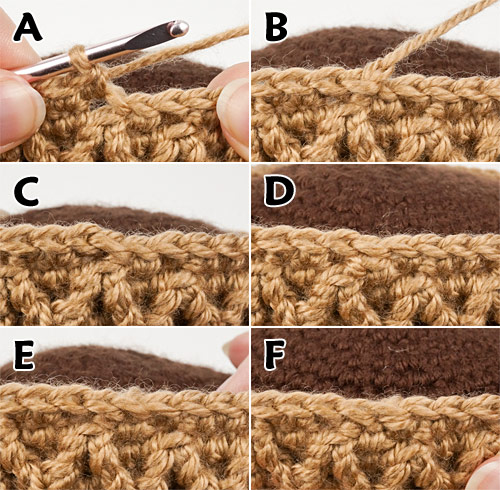
Amigurumi are typically crocheted in the round, in a continuous spiral, which means that the two sides of the crocheted fabric that is produced will look completely different. You can choose which side faces out by flipping the piece inside out at any stage before closing up the piece, and then continuing to spiral around. It doesn’t really matter which side faces out, unless you want to use the invisible decrease technique, in which the ‘right side’ of the fabric has to face outward for the decreases to be invisible.

I keep getting asked which side is the ‘right side’, so I thought I’d put this side-by-side comparison together to show you the differences between the two sides.

The ‘Right’ Side

the 'right' side of a spiral-crocheted piece

  • Each stitch looks like a V shape (I’ve highlighted one in white for you).
  • Note also that you can see the sideways V shapes around the edge that you will crochet into to form the next round.

The ‘Wrong’ Side

the 'wrong' side of a spiral-crocheted piece

  • Each stitch looks (to me, at least) like a pi symbol (π) – but maybe that’s just my geek side coming out again! Otherwise, you could say it looks like a little table – an upside down V with a bar on the top – again, I’ve highlighted one stitch in white for you. You won’t see any of those horizontal bars if you look at the right side – that’s a big clue.
  • Also, the sideways V shapes around the edge of your piece will be facing to the other side, so you won’t be able to see them.

Also, if you’re working ‘inside out’, you’ll be working around the inside rim of the piece – see my Worked inside out section for an illustration of what I mean by that. You’ll probably find that when you start crocheting an amigurumi piece, this is the way the piece will naturally want to curve. You can just flip it inside out so it faces the ‘right’ way after you’ve crocheted a few rounds, and then continue to work around the outside rim after that.

I hope this has helped you to be able to tell the difference between the ‘right’ and ‘wrong’ sides – and once again I’d like to stress that I’m only calling them ‘right’ and ‘wrong’ by convention: there is nothing wrong in having the ‘wrong’ side face out if you prefer the look of the stitches that way, or it’s just what you’re used to. Just remember, if you want to use invisible decreases (which I do recommend; they’ll make your pieces look soo much neater!) you’ll have to crochet with the ‘right’ side facing out :)

UPDATE It just occured to me to add this: If you’re following a pattern that includes complex colour changes (not just simple stripes), or with some stitches worked in back loops or front loops only, you should make sure you’re working the piece the same way out as the designer intended – it will make a difference to the finished appearance!

Share

Comments (15)

fuzzy to brushed crochet tutorial

I know that some people, especially beginner crocheters, are a little scared of my fuzzy yarn patterns. And now that eyelash and novelty yarns aren’t as easy to find as they once were, I wanted to come up with an alternative to give my old patterns (pictured below) a new lease of life…

fuzzy crochet patterns by planetjune

And here it is: you can make them with regular yarn and brush them to make a fluffy animal like the sweet yellow Fuzzy Bear below!

Fuzzy Bears by planetjune, made with eyelash yarn and acrylic yarn (brushed)

And if that, by itself, isn’t enough information for you, I’ve written a whole tutorial on how to convert Fuzzy patterns to Brushed Crochet patterns. The tutorial also features a discussion on back loops only vs crocheting into both loops, and which side is the ‘right’ side when making amigurumi, so it’s worth checking out!

crocheting amigurumi, working from inside and outside

Continue to the Fuzzy to Brushed Crochet tutorial >>

Share

Comments (6)

clean silver with foil

I saved a tweet from @craft_tips:

Warm water, baking soda, aluminum foil. Insert tarnished silver, remove after 10 minutes. Clean!

The idea of a quick and easy method to clean it without any effort was too good to pass up – I have a lot of silver jewellery (because I only wear silver or white gold jewellery) and some is horribly tarnished. I googled to try to find more details and the consensus seems to be that foil, baking soda, a little salt, and boiling water are the magic formula.

Let’s see it in action!

silver cleaning: before
Before (I chose the blackest, most tarnished pieces for this photo. Note also the green tarnish on the two earrings next to the horseshoe charm – I’ll refer to this later!) )

silver cleaning: ingredients
Aluminium foil in the bottom of a glass bowl, with baking soda and a little salt

silver cleaning: bubbles
Boiling water added – bubbles!

I added the jewellery – the trick is to make sure that each piece is in direct contact with the foil. Here comes the science part (I probably haven’t mentioned this before, but I used to be a Materials Scientist in a past life): the black tarnish on your silver is silver sulphide. An electrochemical reaction causes the sulphur to transfer from the silver to the aluminium foil, and the tarnish disappears! You can tell it’s working when you smell the sulphur (bad eggs)…

silver cleaning: dirty water
Look how dirty the water becomes (I’d taken out most of the jewellery by this point)

Most of my jewellery came out clean and shiny. Some had a whitish powdery residue (probably from the salt etc) but after rinsing them in clean water, they were fine. Some still looked black, but the black came off easily when I dried it on some paper towel:

silver cleaning: clean
The remaining black tarnish rubbed off easily on a paper towel

Now here’s something interesting: the silver that started with green tarnish to begin with didn’t get clean – it turned orangey/black. This makes sense – pure silver is very soft, so the standard 925 silver (sterling silver) is made from 92.5% silver, and the remaining 7.5% is often copper. It would have been the copper content in the silver that produced the green tarnish in the first place.

Look at the result of the ‘cleaning’ of the green-tarnished pieces:

silver cleaning: copper
Yuck – discolouration from the copper content in the silver

The good news – this isn’t permanent. I used silver polish on these pieces and they turned back to shiny silver (phew!). But I recommend that if you have any silver with green tarnish, don’t use the baking soda method – it won’t help!

After rinsing (and polishing the copper from the surface of the above earrings), here’s all my jewellery:

silver cleaning: clean shiny jewellery

And here’s the final proof that it does (mostly) work – remember my blackened flower ring from the first picture? Look at it now!

silver cleaning: ring after cleaning
Clean and shiny!

Yay! I can wear it again! And I didn’t have to polish into all those little crevices by hand :)

If you’d like to try this technique yourself, you just need aluminium (that’s aluminum to the Americans) foil, baking soda, salt, and boiling water to make most of your silver look like new again with zero effort! Just don’t forget to rinse the pieces after cleaning (if you leave the salt residue, it’ll corrode the silver).

I hope you found my review interesting – just tell me if I get too science-geeky and I’ll scale it back in future :)

Share

Comments (37)

amigurumi tutorial: fastening off

Okay, so you know all the crochet basics, you’ve mastered the magic ring, you know how to change colours and how to join pieces together, you’re even down with the invisible decrease. What more do you need to know to create the perfect amigurumi?

fastening off (crochet, amigurumi) by planetjune

It’s time for one more tutorial to join my Amigurumi Help resource: how to fasten off. I’m going to cover three different methods:

  1. Closing up a piece
  2. Finishing an open edge that will be joined to another piece
  3. Finishing an open edge that will be visible (a neater finish)

You may think you know it all already, but #3 is another piece of magic that I bet you’ll find useful at some point in the future! Look all around the open edge on this piece – there’s no clunky join in sight:

fastening off (crochet, amigurumi) by planetjune

How did I do it? Check it out here: Fastening Off tutorial.

I was just thinking, with all these crochet tutorials I’ve been writing, I almost have the makings of a book! A handy go-to techniques book. Wouldn’t that be a useful addition to your crochet library? Hmmm….

And, on a related note, if there are any more how-to topics you’d like me to cover, just let me know, and I’ll put some more tutorials together. I hope you’ve realised by now that I’m always happy to help and to share my knowledge :)

Share

Comments (3)

how to: invisible decrease

Remember in the ‘early days’ of making amigurumi, when we didn’t know about the Magic Ring? Remember what an aha! moment it was when you figured out how to do it, and how we’ve never looked back since?

Today I have what I think will be the next aha! moment for amigurumi makers: the invisible decrease. I’m showing it here because nobody I have spoken to knows how to do it (or even that it exists!), and it really does make a difference to the finish of your pieces.

Let’s briefly look at other options for decreasing in single crochet:

  • skipping stitches: leaves gaps in your work where the stuffing can show through
  • sc2tog (sc decrease): leaves a slight bump and a longer bar visible in the stitch

amigurumi decrease problems
L: skipped stitches (arrow marks hole);
R: sc2tog (arrow marks obtrusive ‘line’ made by bar of stitch)

The invisible decrease (invdec) method is different; as good as its name, it’s practically invisible, even if you know what you’re looking for! The reason for this is that it groups the previous stitches together at its base, so the stitch itself looks identical to a regular single crochet.

amigurumi invisible decrease
L: the invdec (marked with arrow) looks just like the other stitches in the row;
R: the result is smooth and even

See? It’s like magic! Now click through to the Invisible Decrease tutorial…

Share

Comments (6)

Next entries » · « Previous entries