
Craft Blog Shop Mailing List

Archive for Polymer Clay

strawberry poison-dart frog sculpture

Over Christmas, we watched David Attenborough’s fantastic Life series, and I’ve had tiny frogs on the brain ever since…

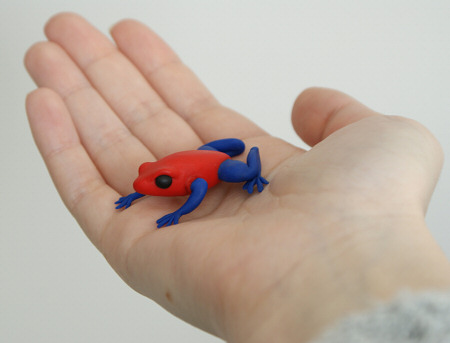
I worked so hard all day yesterday (on the secret project) that I was begging myself to do something relaxing and unrelated to work last night, so I got out the polymer clay and started mixing colours to make a Strawberry Poison-Dart Frog like the one that captured my imagination on Life. While we watched a movie on TV, I played with the FIMO and, 2 hours later, this is what I ended up with:

strawberry poison dart frog polymer clay sculpture by planetjune

Strawberry poison-dart frogs (Dendrobates pumilio) are found in several colour morphs, but the most common (the one I made) is called Blue Jeans for its blue legs – isn’t that adorable?!

I was aiming for a life-sized sculpture – David Attenborough had said that they are only 1 inch long and I’d written that down in my ‘ideas’ notebook along with my sketch – but I didn’t quite manage that. My frog’s body is 1 1/4″ long and including the legs sticking out to front and back, the finished sculpture is 1 3/4″ long (I have small hands, so it’s probably smaller than these photos make it look).

strawberry poison dart frog polymer clay sculpture by planetjune

I’ve surprised myself – I didn’t know I could do this! Yes, it did take me 2 hours, but most of that was spent on the legs. I hadn’t really considered that I’d have to make 16 teeny tiny frog toes until I got to them – not an easy task! I’m happiest with the shaping of the red clay around the eyes – it turned out exactly how I’d hoped.

I think my crafting ‘style’ may be to make things so cleanly that they look like they’d be really easy to make, even though they aren’t. I see it in my crochet designs too – I simplify the shapes and colours to make my patterns easy to follow, but it’s finding a way to simplify them but to keep the most important features of whatever I’m trying to make where this ‘style’ comes into play.

There seems to be a crossover between the different crafts that I do: I don’t think I could have made this frog without my years of examining the shapes of animals for my crochet patterns. I suppose you could call it an “artist’s eye”, although that sounds a bit pretentious so I won’t do that! But it’s definitely interesting how my experience in one medium is indirectly improving my skill and confidence in a completely different medium.

Maybe I should make a matching frog in crochet and compare the two! What do you think?

  • Share/Bookmark

Comments (12)

‘Worms’ in polymer clay

As I’m a bit of a perfectionist (you may have noticed!) I really struggle with quick crafts, because I want everything to be as good as I can possibly make it. Sometimes that’s not healthy: when even my relaxation time is spent being very careful and striving for excellence, I put a lot of pressure on myself. So one of the things I’d like to do this year is to spend more time making ‘fun’ things without caring as much about how ‘good’ they are. And this is my first attempt at that.

Many years ago, I used to love making teeny tiny things with polymer clay – I once made a complete set of Teenage Mutant Hero Turtles (and Splinter the rat) that were each about 1cm tall! I thought it would be fun to try something more like that again – something quick and fun and colourful; almost the antithesis of my 3-years-in-the-making R2-D2 sculpture.

A bit of background for the non-gamers: in the late 1990s, there was a series of multiplayer games called Worms (Worms 2, Worms Armageddon, etc etc). Each player controlled a team of cute worms and took turns to try to annihilate each other by arming their own worms with a selection of outlandish and hilarious weapons. Crazy cartoon carnage ensued. Worms has recently made a comeback with new releases for consoles and iPhone, but 1999′s Worms Armageddon on PC is still a great game too.

Okay, enough talk! Here’s the action shot as the Worms go into battle on my computer keyboard:

Worms (polymer clay) by planetjune
Click through for the bigger pic at Flickr!

And because some of the details don’t show up too well against the black keys, here’s a posed shot of all the pieces:

Worms (polymer clay) by planetjune
Click through for the bigger pic at Flickr!

Worms L-R: no weapon, shotgun, dynamite, bazooka, grenade, no weapon
Back: health crate, mystery crate, oil barrel, super sheep (it’s a weapon!), homing missile, bazooka, mine

A couple of hours well-spent, I think – they just crack me up, especially their little expressions, and the super sheep with his billowing cape :D

  • Share/Bookmark

Comments (33)

polymer clay R2-D2 sculpture

…a project 3 years in the making.

Way back in January 2007, I posted a cryptic wip (work-in-progress) of a FIMO sculpture I’d started:

polymer clay stulpture... in progress!
Can you tell what it is yet? ;)

Yes, I’m a lifelong Star Wars geek, and I was making a model R2-D2. I finished and baked the head, and then… nothing. I’d actually intimidated myself – the head was so detailed and so good that I didn’t think I’d be able to make a body to do justice to it! Also, I really wanted the head to be jointed so that it could rotate, and I wasn’t quite sure how to accomplish that. I filled a page in my notebook with sketches and ideas, but I never got any further than that. And the  longer I waited, the less likely it became that I’d ever finish my R2 project :(

This Christmas, I decided that after working myself so hard for an entire year (never work for me – I am a demanding boss!) I’d take a week off to spend time with Dave and just relax. And relaxing, for me, involves making stuff, so I got out the FIMO and set to work. A week and many baking sessions in the toaster oven later, here is the finished R2-D2:

polymer clay R2-D2 by planetjune
I strongly suggest you click through to see the larger picture! You can’t really see the detail at this scale.

I am so happy with how he turned out! He is perfectly hand-sized at 8cm (just over 3″) tall, and he comes with a secret special feature: yep, I managed to get that rotating head working! I embedded a rare earth magnet into his body, and stuck a second magnet to the base of his head. This lets the head rotate smoothly and freely. Not sure what I’m talking about? Here’s a shot of the inside:

polymer clay R2-D2 by planetjune - head rotation mechanism

(The purple clay inside the body is just a core I made by smushing all my leftover unbaked scraps from past FIMO projects together. As it doesn’t show in the finished piece, there’s no point in wasting a huge lump of new clay, so I made a cylinder from the scrap clay, baked it, and then covered it in a sheet of white clay to form the torso.)

The head magnet fits perfectly inside the recessed hole. There’s a second magnet just beneath the surface of the clay at the bottom of the hole, so the head doesn’t fall off the body but can swivel freely. The rare earth magnets are so strong that, even when separated by a thin layer of clay, you can safely lift R2 by his head and his body will stay firmly attached. Here’s a little animation of his head moving:

polymer clay R2-D2 by planetjune

This project was a great break from my normal life. I love the enforced calm that comes with my polymer clay work.  It’s so detailed and precise that I have to empty my mind and just concentrate on slicing off that sliver of clay, or smoothing out that fingerprint – it’s almost meditative. My batteries are recharged and I’m ready to tackle 2010!

  • Share/Bookmark

Comments (28)

my crafty Christmas tradition

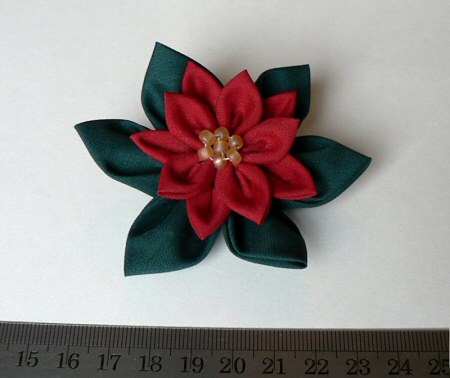
I just realised that, quite by accident, I seem to have developed a Christmas crafting tradition of making poinsettias.

In 2006, I made a kanzashi poinsettia:

tsumami kanzashi poinsettia

In 2007, I designed the famous crocheted poinsettia:

Who am I to break with tradition, even if it’s one I invented myself? So allow me to present the 2008 PlanetJune Poinsettia. This year I’ve gone for a polymer clay (FIMO) variety! It’s just over 2″ (5cm) in diameter, and would make a lovely pin or fridge magnet, or just a pretty decoration.

polymer clay poinsettia by planetjune

If you’d like to try making one, I’ve put together a tutorial for you so you can give it a go. The good news is that it’s much easier than it looks! There’s no precision involved; in fact, the leaves actually look better if they aren’t all exactly the same size and shape. As the instructions are quite long (I’ve included lots of pictures to make it easy to follow), I’ve given the tutorial a page of its own: Polymer Clay Poinsettia Tutorial.

This is my first polymer clay tutorial, so I hope it’ll all be clear. Please leave me a comment if you like it! And would you like to see more PC tutorials in future? Let me know in the comments!

  • Share/Bookmark

Comments (7)

5 minute* project: egg stand

Disclaimer: this is the easiest project ever, and I feel like a cheat even calling it a project! But I’m sure some people will find it useful, so here goes…

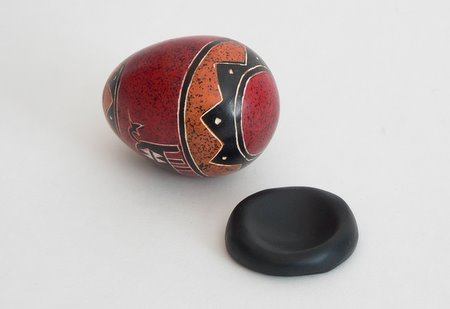
I bought a carved soapstone egg while in England, but I want to stand it up for display purposes, and of course it won’t stand without assistance. FIMO to the rescue…

polymer clay egg stand

Take a blob of polymer clay in a colour that coordinates with your egg. The size depends on the size of your egg – it has to be large enough to support the egg. Play with the clay until it is soft, then roll it into a ball. Place it on your baking surface (I use a ceramic tile, but you could use a cookie sheet with a piece of aluminium/aluminum foil on top).

Push the clay down onto your baking surface so it has a flat base and a flattish top (if you use a hard flat surface to push gently down on the clay, you’ll avoid fingerprints – I don’t bother and just smooth the prints away later with my finger). Now take your egg and centre it upright over the clay, then push it down into the clay to make a deep depression in the top of the clay that is the same size and shape as the base of the egg. Remove the egg from the clay. Gently smooth any uneven patches with your finger. Decorate if desired.

polymer clay egg stand

Do not lift the clay from the baking surface – you want the base of the stand to stay flat. Transfer the baking surface to the oven and bake according to manufacturer’s instructions. When it has cooled, you can pop the clay egg stand off the baking surface if it has stuck – it won’t be baked onto the surface.

Paint, finish, varnish etc, if desired – I left mine plain black so as not to detract from the egg. Place your egg in its stand and admire!

polymer clay egg stand

*5 minutes does not include the baking time, obviously!

  • Share/Bookmark

Comments (3)

« Previous entries