
Have you ever tried to crochet a really tiny tube or cylinder? I find that single crocheting in a ring with 5 stitches is challenging enough; let alone trying to make a 4-sc cylinder, or, almost impossibly, a 3-sc tube.
Knitters are lucky; they have a great way to make a very fine tube – it’s called an i-cord and it’s really easy to knit up on dpns (if you knit). But I have great news for you: you can also make i-cord using your crochet hook!
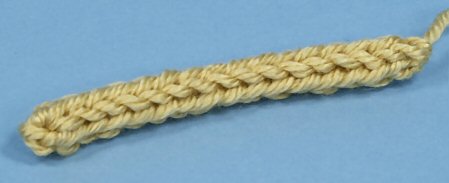
It’s very simple once you get the hang of it, and it’s an easy way to make fine tubes, as long as you like. You can use i-cord in amigurumi, as trim, or even to make bag handles. It’s versatile and works up quickly.
Note: you can also make a wider i-cord tube, by starting with more chains and dropping all but one loops off the hook. I’d recommend you don’t go too wide though, as it’s easier to accidentally pull out one of the dropped loops when you have more of them in play. I’d recommend you stick with a 3-ch or 4-ch crocheted i-cord. For anything wider than that, make a sc spiral (or learn to knit it on double pointed needles).
The easiest way to explain it is to show you, so I’ve made a video showing how to crochet an i-cord. And because I’m nice like that, I’ve done right-handed and left-handed versions.
Crochet an i-cord (right-handed)
Click to watch this video on YouTube.
Crochet an i-cord (left-handed)
Click to watch this video on YouTube.
See – it’s easy!
If you’d like to practice crocheting i-cord, I’ll have a new pattern that uses this technique available in a few days…
UPDATE: By request, here are my written instructions to crochet i-cord:
Crochet an i-cord (text instructions)
- Ch 3. Insert hook into 2nd ch from hook, yarn over and draw up a loop, insert hook into next ch, yarn over and draw up a loop (3 loops on hook).
- Row 1: Drop 2 loops from hook. Hold onto the dropped loops with your non-hook hand so they don’t come undone. Yarn over and draw through remaining loop on hook. Insert hook into first dropped loop, yarn over and draw through (2 loops on hook). Insert hook into second dropped loop, yarn over and draw through (3 loops on hook).
- Repeat Row 1 for desired length of i-cord. Cut yarn, leaving a long yarn end. Draw end through all 3 loops on hook and pull tight to fasten off.
That’s it!
Bonus Tips
Finishing a crocheted i-cord:
- The easiest way to end the final row is to cut the yarn leaving a long end, draw the end through all 3 loops on the hook, and pull tight. This will draw the end into a point.
- To maintain the tubular shape to the end, wait till you have all 3 loops on the hook, then sl st through each loop in turn, fasten off, and use the yarn end to stitch the first and last sl sts together into a circle.
- For finishing, it depends on what you want to do with the i-cord: use the yarn ends with a yarn needle to stitch it to something else, or hide the ends by weaving them up through the middle of the tube.
Make an attached i-cord as an edging for a blanket (or other crocheted project):
To save sewing the i-cord edging on afterwards, you can crochet it directly around the edge of your blanket.
- Right-handed: After putting the 3rd loop back on your hook, insert your hook into the next stitch along the right edge of the blanket, then draw up the loop (the ‘chain 1’) back through both the blanket edge AND the 3rd loop on the hook. If you do that for every row (or every other row, for speed) of the icord, you’ll attach the left edge of your i-cord to the edge of the blanket as you crochet the i-cord.
- Left-handed: After putting the 3rd loop back on your hook, insert your hook into the next stitch along the left edge of the blanket, then draw up the loop (the ‘chain 1’) back through both the blanket edge AND the 3rd loop on the hook. If you do that for every row (or every other row, for speed) of the icord, you’ll attach the right edge of your i-cord to the edge of the blanket as you crochet the i-cord.
Loved this tutorial? I have so many more amigurumi tips and tricks to share with you!
Boost your amigurumi skills with my latest book, The Essential Guide to Amigurumi, your comprehensive guide to amigurumi techniques and tips.
Do you find my tutorials helpful? If so, please consider making a contribution towards my time so I can continue to create clear and concise tutorials for you:
Thank you so much for your support! Now click below for loads more crochet video and photo tutorials (and do let me know what else you’d like me to cover in future tutorials…)
















Stacey Moran said
This is an excellent and well-explained tutorial for creating an I-cord with crochet!
Thank you.
Mia919 said
This is fantastic! I’ve previously worked with knitted i-cord attached borders and have been searching for a crochet alternative for an entrelac baby blanket. This method looks brilliant—likely quicker than a knitted i-cord border. I truly appreciate it!
Mia said
Thanks a lot. I needed it to prove to my friend that I am as good as she is. It’s really easy to understand, it’s lovely.
dzanit said
Thnks for sharing I like it. 🙂
Sheryl K said
I have a small statue figureen, that had a cactus implanted in it’s head. My grandson gave it to me. Eventually, the cactus died (?) so it had a hole in the top of the head, about the size of a dime, and about 1/2 ” deep. I had no clue how to fill it. I just read how you make an i-cord, so my plan is to make about 6 or 7 i-cords from threads, and glue them into the hole. It will look like hair. Thanks so much. you have no idea how happy I am, to be able to keep this small gift to remind me of my onderful grandson!:grin::smile:
Catherine said
Hi June !
Thank you very much for these CLEAR instructions ! I ‘ve been trying to crochet an i-cord for months but didn’t find any clear instructions for that.
Thank you, once more
Regards,
Catherine
SHARIPAH AMINAH BINTI ZAINUDDIN said
you didnt show how to make the finishing. how to put on handbag. i do by my self but its not nice
Deborah said
Thank You for such clear instuctions. The video for left handed came in handy! I was wondering what size hook you used in video.
June said
You’re welcome, Deborah! All my crochet videos have left-handed versions 🙂
For this video, I used an E US/3.5 mm hook (but you can use any size that gives you a cord you like the look of with the yarn you’re using) – you can also use this technique with any yarn weight, if you want to make a finer or chunkier cord.
Glenda Nobbs said
I wanted to make an i chord in crochet and your tutorial was great and very easy to follow. Thanks so much. Glenda
Alexandra said
Thank you for this great tutorial, the best I’ve found to make an i-cord!!! Alexandra
Sandy said
This is great; I have done knitted icord attached borders and am looking for a crochet alternative for an entrelac crochet baby blanket. Brilliant! Probably faster than knitted icord border. Thanks so much.
Nisan said
Hi …. Thank you for your video on how to make an I cord. I’m making a bag for my little daughter and I was wondering how can I attach this cord the my bag.
Thank you and good luck with your future projects ?
June said
Nisan, please see my previous response to this question, here 🙂
AC said
Dear June,
Thank you so VERY much for this tutorial, especially the left-hand video and extra text information on how to finish an edge with i-cords. It looks SO much better than crocheting over floating yarn! 😉 This is nothing short of pure
gee-ni-us!!! Blessings and hugs!
Christel said
Thank you for this wonderful explanatory video. So easy to follow! You hold the yarn in the European way, I do too, so much easier. Thanks again, I will check out your website!
Karen Lally said
I am trying to make Celtic knots to add to an Aran afghan. Is there a way to make the cords appear more rounded or pointed at different places in the cord. I would like to use a single cord to create various Celtic knots but I’m not sure if some of the more pointed or rounded areas need extre definition or if just correct placement will achieve the look I need (like the trinity knot or triquetra Thanks
June said
I’m afraid that’s not something I have any knowledge of Karen, sorry! It’s well outside the scope of this tutorial.
Frances Landsberg said
Hi, June.
Greetings from South Africa. 🙂
Thanks very much for this tutorial. My question is how would one crochet the i-cord as the handle for a handbag? Would you crochet it directly onto the handbag as with the blanket, and where would you start?
Thanks
Frances
June said
Frances, design advice is beyond the scope of this tutorial, but there are many ways to add a corded handle to your handbag! For example, you could make separate cords and attach each one as a handle, or make an i-cord edging around the top of the bag and leave part of the cord detached on each side to form the handles – it depends on the look you’re going for. There’s no right or wrong answer; if you want to design your own bag handles, experimenting is a part of the process 🙂
Lisa said
Your tutorial is very easy to understand, Thank you so much!
EDITH said
What a fantastic tutorial for doing an I-cord using crochet!
THANKS!
Georgia Brady said
I have been unable to find good instructions for invisibly joining attached or applied i cord ends. Can you recommend a method?
June said
I’m afraid that’s outside the scope of this tutorial, Georgia, but if you Google for ‘join icord ends’ you’ll get lots of results.
Michelle said
I just wanted to say thank you for posting this! It is exactly what I needed.
Maggie said
Brilliant, June. Its a much quicker way than i have been doing them. Thank you x
Valqu said
It’s a fantastic explanation, thank you.
Margaretanne said
thank you that was beautiful, thanks again
Kerry (beluke on Rav) said
Thanks so much for sharing this – really helpful.
I’m wondering if it’s possible to do an attached I-cord as you go (as you can do with knitting) so I could maybe have an I-cord running around the edge of an afghan as I create it (rather than do a border when I’ve finished the main body of the project?
June said
Hmm, it should be possible, but the problem I see is you’d have to leave the 3 i-cord loops live until you get back to them in the next row, so you’d have to slip them onto a stitch holder each time. It’d be simpler to make an attached i-cord after completing the project – I’ve added some instructions for that at the end of the post above.
Kerry (beluke on Rav) said
Wow – that was so kind of you to add that – and so quickly too. Many many thanks.
Lyndsey said
Hi June ?
Thanks for the tutorial ive been looking at different ways of how to make crochet cords as I have started making bracelets. This looks so easy. Thanks for sharing.
Take Care 🙂 x
Terrie said
That is so cool. Could I use beads on loop one?
June said
Thanks Terrie! As with all crochet, you can add beads to any or all of the loops – experiment to see what gives you the effect you wish to achieve 🙂
Kaelynne Marie said
Just wanted to thank you for this pattern! Super easy and sooooo pretty! What is your YouTube channel I’d love to subscribe;)
June said
Thanks, Kaelynne! I’m ‘PlanetJune’ everywhere – you can find my YouTube channel at www.youtube.com/planetjune 🙂
Donna Gould said
June, this is exactly what I was looking for. Thank you so much!
Karen said
Hi June,
I found your video on the I-cord very easy to understand. I would appreciate it if you could email the directions in text form.
Thank you
June said
Karen, I’ve added the text instructions to the end of the above post, in case other people would like them too 🙂
ann said
THANKYOU! a great tutorial.. really appreciate you sharing this easy technique!
Isobel said
Brilliant tutorial, so clear and easy to understand. I’ve just made a huge chain using a stretchy jersey yarn and a 10mm hook to make a necklace and it’s turned out exactly how I wanted it.
Becca86 said
I’ve always thought perfect tiny tubes were for experimented crocheters only. Mine always turn out very ugly and seem to shrink on themselves for some reason (which is probably because I’m just doing them wrong). Thanks to your tutorial, I can do them just fine now! =D
maria de lourdes klering said
muito bem explicado,lindo trabalho.
Thandie said
Hi June,
Thanks for answering my last question. But now I’d like to know how do we finish off and join the two ends of the icord? I’m trying to make a necklace.
Thanks
June said
That’s outside the scope of this tutorial. You’ll have to figure out a way to sew the ends together; just make sure you stitch through each of the remaining 3 live loops so your cord doesn’t unravel! See the Bonus Tips at the end of the post above for some starting points.
Thandie said
Hi June. What size hook are you using? And yarn? Thanks Am trying to make tube necklaces and want to get the right gauge. Thanks 🙂
June said
I used worsted weight yarn and an E hook, but you can make an i-cord in any gauge – you’ll just end up with looser or tighter loops. You should experiment until you find the look you like best.
Dawnroll said
I like to crochet to make for xmas
RuthT said
Such wonderfully clear instructions! Thanks so so much for sharing!
Roc said
Thank you very much for the demostration. Specially for the right hand :)))
Kelly Champion said
I agree that in the beginning it looks flat with the sides curling in but after several rows, if you stretch it a bit and roll it between your fingers, the seam literally closes and disappears. Awesome technique. Thank you .
pat said
genius! best idea i have seen in a long time. thanks
theresa milstead said
l came across this on Pinterest … perfect timing. Thanks for taking the time to share. (I left a comment on youtube, too.)
Laura said
Thank you so much! This is exactly what I needed. Your video is so helpful that even though I have no sound on my computer I was able to understand exactly what I needed to do! Thank you!
Sandra said
Hello.
Can you do it bigger. I mean with more than three stitches??
Thanks.
June said
Sandra, please see the note above the videos – I’ve answered your question there 🙂
C said
Thank you so much for the technique, I wanted something similar to the French knitting cord and this is perfect.
And it’s so simple too 😉
With regard to the comments above, they must be missing something out as by the 4th round I was already noticing a “closed” tube forming and I’ve used all kinds of yarn, even the cheap variety and it all works perfectly.
Thanks again for sharing x
J Niskanen said
I wanted to make a little Amigurumi fedora for a doll and I needed an oval shape to start and act as a top. The only tutorial I could find for making an oval suggested crocheting on both sides of a chain but that left a series of noticeable holes up the center. From the base it was rounded off with increases at the corners. Could this technique be used as the starting point for making an oval or do you have a better idea?
Barbara said
Thank you for your demonstration. I found it very clear to understand.
Barbara Tschudy said
Hi:
I am amazed with this i-cord. It was a little tricky at first especially remembering to Chain 1 before you insert your hook into loop 2. Thanks so much for this new way to do i-cord. I like the way it looks. I am making a headband with it I like it so much. Your website is like the greatest too.
Thanks so much for all your tips
Barbara