Craft Blog Shop Mailing List

clean silver with foil

I saved a tweet from @craft_tips:

Warm water, baking soda, aluminum foil. Insert tarnished silver, remove after 10 minutes. Clean!

The idea of a quick and easy method to clean it without any effort was too good to pass up – I have a lot of silver jewellery (because I only wear silver or white gold jewellery) and some is horribly tarnished. I googled to try to find more details and the consensus seems to be that foil, baking soda, a little salt, and boiling water are the magic formula.

Let’s see it in action!
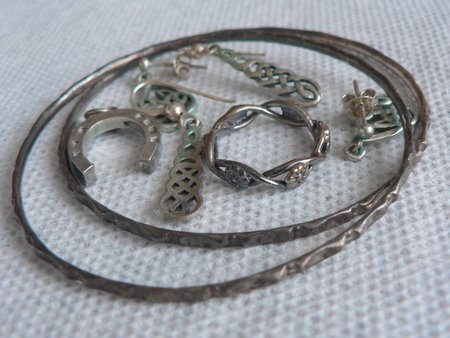
silver cleaning: before
Before (I chose the blackest, most tarnished pieces for this photo. Note also the green tarnish on the two earrings next to the horseshoe charm – I’ll refer to this later!) )
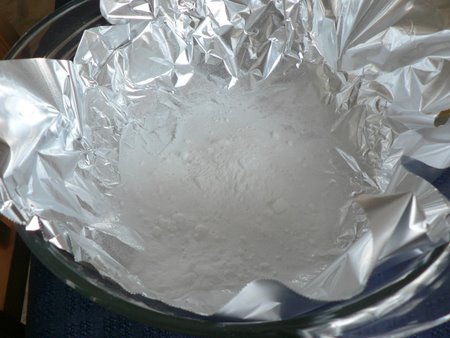
silver cleaning: ingredients
Aluminium foil in the bottom of a glass bowl, with baking soda and a little salt
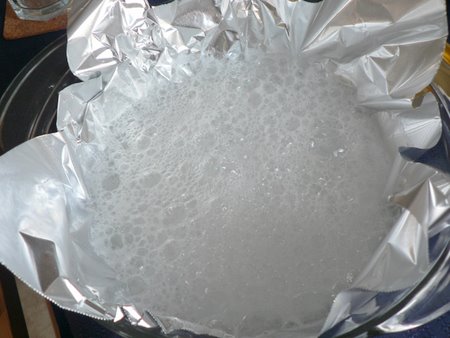
silver cleaning: bubbles
Boiling water added – bubbles!

I added the jewellery – the trick is to make sure that each piece is in direct contact with the foil. Here comes the science part (I probably haven’t mentioned this before, but I used to be a Materials Scientist in a past life): the black tarnish on your silver is silver sulphide. An electrochemical reaction causes the sulphur to transfer from the silver to the aluminium foil, and the tarnish disappears! You can tell it’s working when you smell the sulphur (bad eggs)…
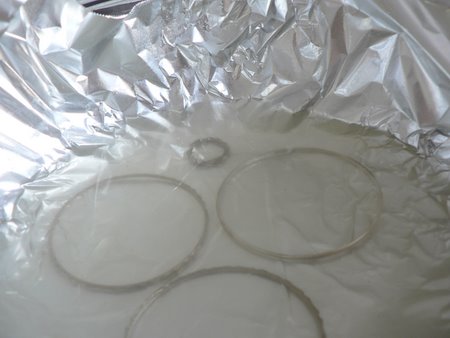
silver cleaning: dirty water
Look how dirty the water becomes (I’d taken out most of the jewellery by this point)

Most of my jewellery came out clean and shiny. Some had a whitish powdery residue (probably from the salt etc) but after rinsing them in clean water, they were fine. Some still looked black, but the black came off easily when I dried it on some paper towel:
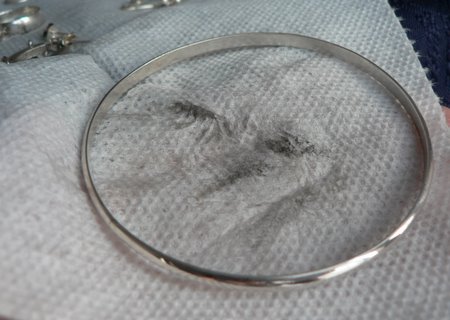
silver cleaning: clean
The remaining black tarnish rubbed off easily on a paper towel

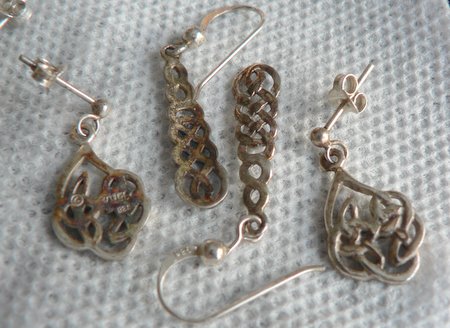
Now here’s something interesting: the silver that started with green tarnish to begin with didn’t get clean – it turned orangey/black. This makes sense – pure silver is very soft, so the standard 925 silver (sterling silver) is made from 92.5% silver, and the remaining 7.5% is often copper. It would have been the copper content in the silver that produced the green tarnish in the first place.

Look at the result of the ‘cleaning’ of the green-tarnished pieces:
silver cleaning: copper
Yuck – discolouration from the copper content in the silver

The good news – this isn’t permanent. I used silver polish on these pieces and they turned back to shiny silver (phew!). But I recommend that if you have any silver with green tarnish, don’t use the baking soda method – it won’t help!

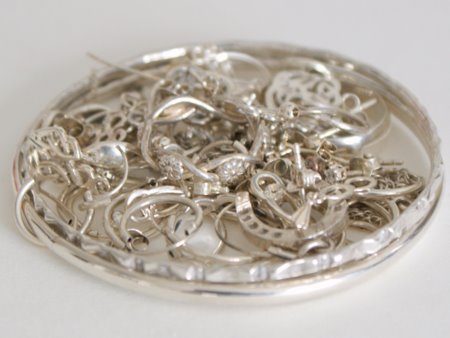
After rinsing (and polishing the copper from the surface of the above earrings), here’s all my jewellery:
silver cleaning: clean shiny jewellery

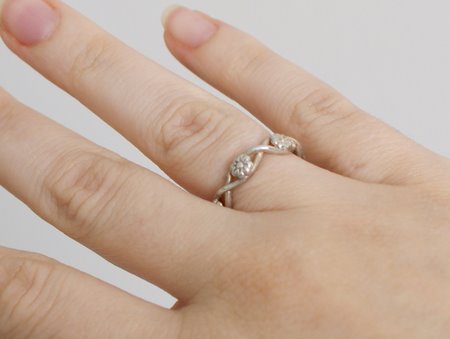
And here’s the final proof that it does (mostly) work – remember my blackened flower ring from the first picture? Look at it now!
silver cleaning: ring after cleaning
Clean and shiny!

Yay! I can wear it again! And I didn’t have to polish into all those little crevices by hand :)

If you’d like to try this technique yourself, you just need aluminium (that’s aluminum to the Americans) foil, baking soda, salt, and boiling water to make most of your silver look like new again with zero effort! Just don’t forget to rinse the pieces after cleaning (if you leave the salt residue, it’ll corrode the silver).

I hope you found my review interesting – just tell me if I get too science-geeky and I’ll scale it back in future :)

  • Share/Bookmark

33 Comments »

  1. Ann said

    Wow – look how bright and shiny! I’m impressed and will try this in the future. Gotta love a ‘no work’ method; it’s good to save our fingers for other things like crocheting and paper rolling, right?! Never knew it as anything other than aluminum – so you taught me TWO things today. :-)

  2. Reba said

    Thanks for the tips! :)

  3. SiSi said

    very neat trick June,
    Thanks for trying it out and letting us know. I’ll be sure to keep this in mine the next time I need to clean my silver jewelry:)

  4. Carina said

    Science-geeky is NOT a bad thing, m’lady! (-;

    Thanks for posting about this!

  5. Aveen said

    I tried this for the first time about a year ago and was astounded at the results! Love the before and after photos. Just be careful if you have any oxidised jewellery (i.e. blackened as part of the design) as this method will lift off all the black – I ruined a Celtic-style ring!

  6. bjewelled said

    Good point by Aveen! Never use this method, or any liquid dip cleaner, on jewellery that has been deliberately “oxidized”, i.e. tarnished, such as much of the silver jewellery from Bali and Indonesia. A regular polish with a proprietary cloth is all that is normally required.

    Of course, the best method of avoiding tarnish is to wear the jewellery – the constant movement against your clothes and skin will keep it shiny. But, if not being worn ensure the jewellery is kept in a pouch or jewellery box to minimize exposure to the air – sulphur in the atmosphere is the main cause of tarnishing.

  7. futuregirl said

    Oh, no! It’s not to science geeky. This is great! :)

  8. Denise said

    That was great. Geeky, but geeky is good :) It helped explain what’s going on. I’d love more posts like this if there’s a chance.

  9. Idadown said

    The aluminium is a more reactive metal than silver; meaning it has a greater affinity for the sulfur ions than the silver (silver sulfide is the oxide). So the aluminium strips the sulfur from the silver, forming aluminium sulfide, and leaving silver metal (nice and shiny).

    Silver reacts very readily with sulfur, hence traditionally it was a no-no to eat eggs with a silver spoon. It does not react with oxygen. Hence silver can take a long time to tarnish, depending on how much sulfur is comes into contact with.

    Aveen: you can retarnish your silver by letting your ring react with the sulfur in the yolk of a boiled egg. This website has some nice recipes: http://www.finishing.com/1000-1199/1178.shtml

  10. Amanda said

    June, I was RIGHT NOW about to buy a jewelry cleaning kit for my tarnished silver. :o THANK YOU!

  11. Jefferson said

    Impressive method and thanks for sharing it. I guess its the baking soda that does the bulk of the work, all that fizzing will loosen the dirt. Does this work on other metals? I would imagine so.

  12. What a nifty little trick! I am definitely going to have to try this! I LOVE little tips like this!

  13. Katrin said

    Hi June. That´s really a good trick. But be careful: What happens during that process is that aluminum-ions are substituting some of the silver-ions on the surface. It´s like a very, very thin aluminum coat on your silver items. So my suggestion is not to do it to often. Especially on only silver-coated jewelery cause you don´t want to have more aluminum-jewelery than silver, right? ;)

  14. amber said

    For jewelry that isn’t too badly tarnished you can try toothpaste. Any standard toothpaste with fluoride will work. Just put a dab in the palm of your hand, roll the piece of jewelry around for a few minutes and then rinse it off. It comes out untarnished and shiny! Not sure what the science is behind it, but I guess some sort of reaction with the fluoride?

    That’s a method my mom taught me when I was little and she didn’t want me playing with boiling water.

    amber

  15. amber said

    For jewelry that isn’t too badly tarnished you can try toothpaste. Any standard toothpaste with fluoride will work. Just put a dab in the palm of your hand, roll the piece of jewelry around for a few minutes and then rinse it off. It comes out untarnished and shiny! Not sure what the science is behind it, but I guess some sort of reaction with the fluoride?

    That’s a method my mom taught me when I was little and she didn’t want me playing with boiling water.

    amber
    Oops…forgot to say great post! Looking forward to your next one.

  16. June said

    Okay, I was trying not to bog you down with too much science, but as some of you are interested, I’d better set a few things straight!

    1. How it works
    The water + baking soda + salt form a pathway that conducts electricity between the silver and the foil. An electric current forms and the sulphur transfers from the silver to the aluminium – as Idadown says, this is because the alu is more reactive and so the sulphur ‘prefers’ the alu to the silver (and no, the aluminium is not being plated onto the silver!).

    2. How do we know this is happening?
    Firstly, you can smell the sulphur after it is released from the silver (the bad egg smell – this is actually hydrogen sulphide gas, produced by a secondary reaction between the alu sulphide and the water). Secondly, the ‘dirt’ you can see in the water above are actually tiny yellow flakes of aluminium sulphide.

    3. Why is this such a good method?
    This is a non-destructive process – the sulphur is removed from the surface of the silver, but none of the silver atoms are touched. Regular silver polish, or cleaning with toothpase, both contain abrasives that remove the silver sulphide from the surface. This means that, over time and with repeated cleanings, your silver is worn down more and more each time you polish it. This is especially important to avoid with silver plated items, as you can wear the plating right down and expose the other metal beneath!

    And one more thing – if you do accidentally remove the black layer from deliberately ‘oxidised’ jewellery, Idadown’s boiled egg method should fix it! The jewellery will become completely black from the sulphur in the egg. Then you can polish the raised areas with a silver polishing liquid or cloth, leaving the blackened surface in the lower areas. Fixed!

    Here ends today’s science lesson :)

  17. Robyn said

    This reminds me of a science project I did in grade school. I put salt and lemon juice in a glass bowl,then put in really dirty coins and something in the salt and lemon would shine them right up! Seemed to work better on pennies.Don’t know if the copper had something to do with it but it was a fun project. What memories. Man I feel old now! LOL!Oh and awesome job again June. See ya on Facebook!

  18. Jana said

    Hi, June! What a great tip! One question, though, how MUCH salt and baking soda should I put in???
    I am home in Saudi now. Got in around midnight last night. Hopefully the jet lag won’t last but another day or so and then I plan to do my punchneedle! Yay!

  19. Lee said

    Can I use this method on silver jewelry with stones in it? Not precious gems, but moonstone or pearls or even just glass.

  20. June said

    Jana: I put in enough baking soda to cover the foil, and just a pinch of salt.

    Lee, I’m no expert, but I would say it depends how your stones are mounted:

    If they are fixed in a silver setting, there should be no problem with glass or stones – the stones will not react with the baking soda solution – just remember to rinse them in water immediately after removing from the solution.

    If they are glued in place, there is a chance that the glue will react with the solution, or even melt in the boiling water. I didn’t see a problem with my jewellery (I had some cubic zirconia (fake diamond) stud earrings and they were not damaged when I cleaned them in this way.

    One important caveat: pearls are NOT stones and must be treated very carefully with only a damp cloth or a very mild soap solution. NEVER put pearls into a baking soda solution!

  21. ed hardy said

    It was a very nice idea! Just wanna say thank you for the information you have shared. Just continue writing this kind of post. I will be your loyal reader. Thanks again.

  22. Abi said

    That’s so awesome, I”m going to clean some of my jewellery now. But I have a question, will it ruin a necklace that has beads with the silver?

  23. Tiffany said

    Thank you for sharing this great info! We are going to be mentioning your blog on this Sunday’s Inspired at Home Radio show. http://www.inspiredathomeradio.com

    Creatively,

    Tiffany

  24. Jen said

    I LIKE science geeky!

    This is a good, classic method for cleaning silver. Thanks for reminding me of it!

  25. aya from Israel said

    thank you thank you thank you thank you thank you thank you thank you

    i have some stuff: cups, box, Yudaika and (of course :-) ) jewels.
    Most of them I inherit recently…. they weren’t cleaned for years, decades actually.
    I stumbled upon your blog, read your method and went immediately to try it.
    I’ve “spent” the last hour cleaning some of it with your instructions… amazing results
    well now I have to buy some more backing soda and go on with the cleaning
    SOOOOO EASY, SUCH GREAT RESULTS

  26. Mary said

    What ratio of ingredients do you use in your mixture?

  27. June said

    Mary, as I mentioned in the comments above, I put in enough baking soda to cover the foil, and just a pinch of salt :)

  28. wnda lee said

    Great instruction, very good tip, and pls don’t scale back the science, it works for the likes of Alton Brown on ‘Good Eats’, it’s the best part. Thanks v.much

  29. Verena said

    Please keep it science geek-y. I am a med student and prefer to know the real mechanisms, especially when I can later apply the principle to something else.

  30. Andrew Lewis said

    Does this work as well for silver plated items. Also I have silver plated handle knives with, of course, non silver metal blades. Can I use this method for them as well?

  31. June said

    Andrew: yes, it should work well for silver plated items- it’s actually preferable to silver polish which would wear away more of the silver plating each time you polish it.

    As for the non-silver knife blades, they shouldn’t be affected by this method. They won’t be cleaned, of course, but they shouldn’t be harmed when you clean the silver handles.

    Just remember, in all cases, to rinse the pieces thoroughly as soon as you remove them from the solution, to rinse away the salt residue.

  32. Just wanted to let you know that the header icon on the website appears to be corrupted, there’s a large quanity of brown and green lines running across it.

  33. it is very nice

RSS feed for comments on this post · TrackBack URI

Leave a Comment

Please note that I respond to comments here on the blog, so please return to this post to see my reply, or check the above box to subscribe to comments on this post by email. -June

Please leave these two fields as-is:

Protected by Invisible Defender. Showed 403 to 7,028 bad guys.