
Cape Town wildlife VI
This is the sixth post in my monthly series on the fascinating nature I encounter here in South Africa. I’ll be back with another crochet post tomorrow!
How could I possibly top last month’s wildlife post? Short of going on a safari, I don’t think it’s going to get much more impressive than penguins and whales and lizards and dassies, all in one day! So I’m narrowing my focus a bit and I’m going to show you something much closer to home (my own back garden, in fact) that’s an absolute miracle of nature.
As you may remember, a few months back, we noticed some weird blobs on the wall of our house, that turned out to be Garden Acraea butterfly cocoons. It turns out that we have a perfect butterfly ecosystem in our garden: we have a Wild Peach (kiggelaria africana) tree (unfortunately no relation to an edible peach) where the butterflies lay their eggs.
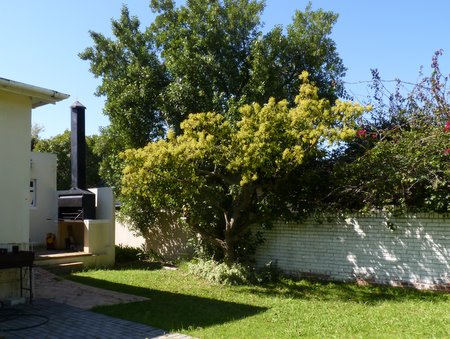
The wild peach is the larger, darker tree at the back. The butterfly wall (left of photo) faces the tree.
As winter ended and spring began (I’m in the southern hemisphere, remember), the cycle started up, and I’ve been able to observe the whole fascinating process just by stepping out into my garden!
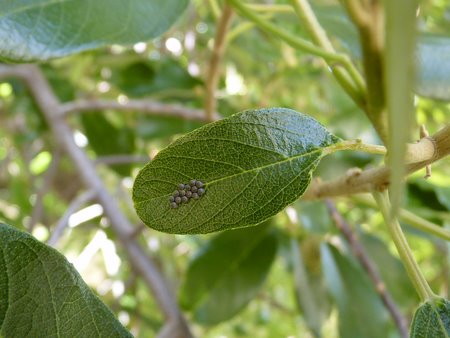
Butterfly eggs
After hatching, the little caterpillars feast on the wild peach leaves (which grow back quickly – don’t worry about the tree). Apparently cuckoos eat the caterpillars, although I’ve yet to spot one on our tree. And when the wild peach fruits ripen (from February) they apparently attract a whole host of different birds, so I’ll report back if we see anything interesting 🙂
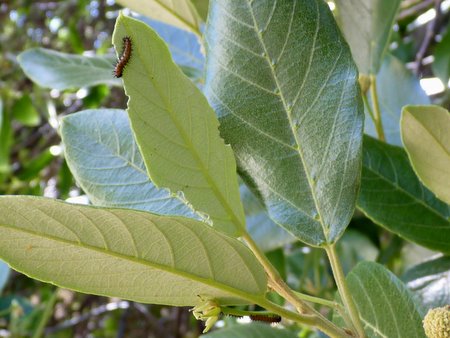
Baby caterpillars and munched leaf
When the caterpillars are fully grown, they find a convenient sunny wall to attach themselves to before pupating. They spin a silk mat and grip onto it with proleg hooks called crochets (of course, crochet means hook in French, so that’s not really a huge coincidence, but it still made me smile!)
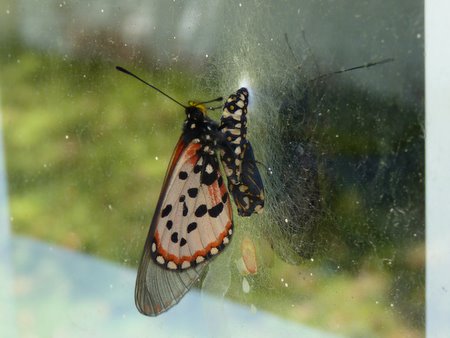
You can see the silk mat clearly when the caterpillars form their chrysalises on a window instead of the wall. (This butterfly had just emerged from his chrysalis.)
So here’s the puzzle: how does that butterfly, with those big wings, come from that skinny little chrysalis?
Like this! As the butterflies emerge, the wings are curled and crumpled. They straighten and unfurl, in the slowest of slow motion. Here’s a sequence of photos to demonstrate:
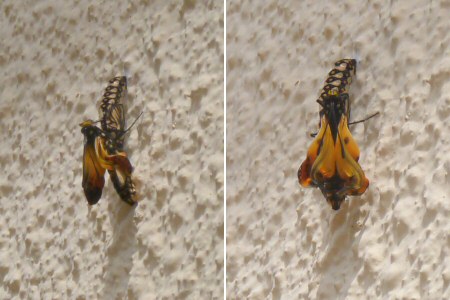
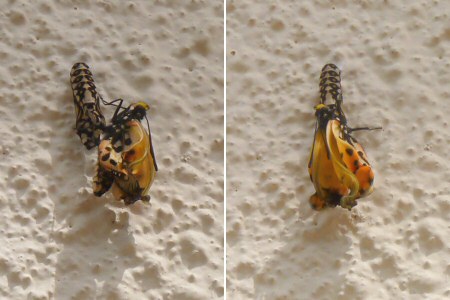
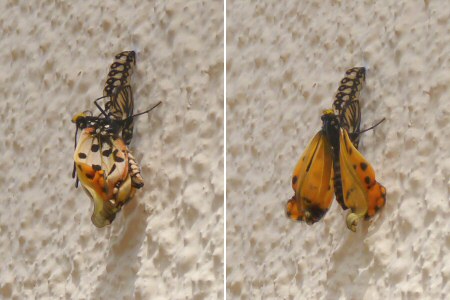
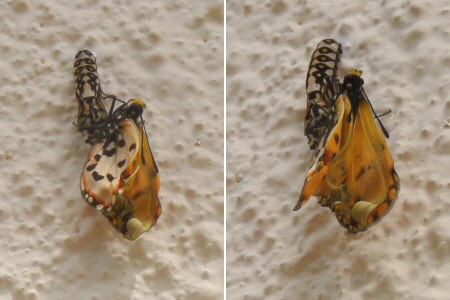
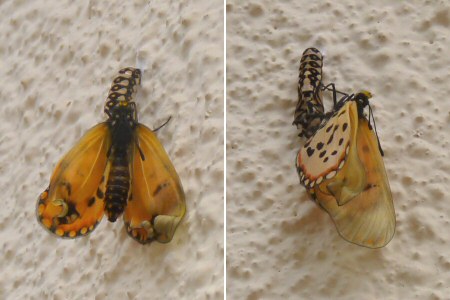
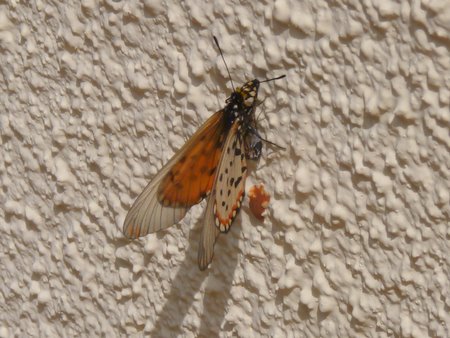
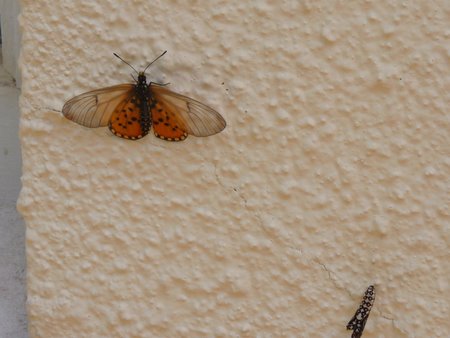
This takes about an hour. At the end of this the wings are really frail and floppy – the slightest breeze makes them flap all over the place and almost pulls the butterfly from the wall! The butterfly rests with all her wings held together so the wind doesn’t catch them and waits for another hour or so while her wings strengthen. Then she abandons the cocoon and climbs slowly up the wall, flapping her wings to test them:
And then she’s off!
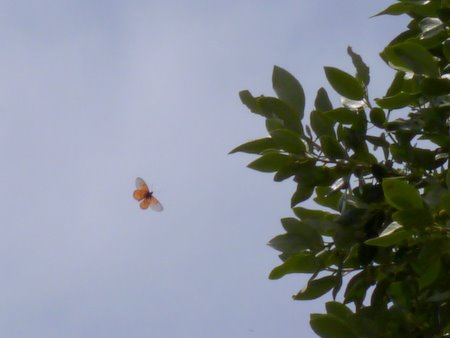
Flying back to the wild peach tree
Nature is pretty amazing, don’t you think?
Whatever else is going on, there’s magic everywhere in the world if you just slow down and look for it. Today I’m sharing mine with you – I hope you enjoyed it!













 Email newsletter
 RSS
RSS Twitter
 Facebook
 YouTube
 Ravelry: June
 Instagram
Lynn said
Wow, what detailed pics of the butterfly. Can’t wait to see the birds when the fruit ripens on the peach tree.
Kateryn said
Very nice, June! Again, I can only approve of more posts that talk about insects. Very nice photography, excellent research. Since I know you like to be thorough, I will add that this is a Nymphalid butterfly known as the Garden Acraea (Acraea horta).
Thanks for sharing Spring with us – it’s greatly appreciated!
June said
That’s right, Kateryn, well identified 🙂 And, I didn’t want to bore people with too many facts in the post, but as you’re interested, I’ll add that the butterfly on the window is a male (bright, reddish coloured), and the ’emerging’ sequence is a female (duller, more yellowy coloured). I love knowing this stuff so I can recognise them when I see them!
Hilary said
Hi ~ this is my first visit to your blog, these photos are amazing, the process of emergence is beautiful, I am so glad you captured each stage of the process, and thank you so much for sharing. 🙂
Jazz said
Thanks for sharing these amazing photos!
June said
I’m so glad you’re still enjoying these posts! It takes me hours to put each one together, but I love doing it – it gives me a nice reminder to look back over later, instead of having hundreds (thousands!) of unedited photos sitting on my computer and never getting looked at.
karen said
I always enjoy your wildlife pics but this was certainly special.
Susan said
How awesome. I mean that in the awe-inspiring way. Great photography. What patience it must have taken to capture all of that. I am so thankful that you did. You are a wonder, June and I enjoy all of your posts.
Lindy said
Great photography & description! So interesting.
Love, Lindy xx
Gillian McMullen said
Oh June, this is just wonderful!
Jody Ouradnik said
Absolutely amazing, June! Thanks SO much for sharing. We are just beginning the “descent” into winter here in Minnesota, so it’s fun to see pictures of new life emerging somewhere else on this fantastic planet, as my own backyard looks forward to heaps of white stuff coming soon!
Leanne Musso said
June,
This is awesome!! Thank you for sharing!!! I look forward to your posts 🙂